
Introduction: Welcome to the GCC’s New Growth Frontier
Last Updated: 28.04.2026
For global entrepreneurs, family offices, and established brands alike, the Gulf Cooperation Council (GCC) and in particular UAE represents one of the world’s most dynamic growth corridors. The UAE sit at the heart of that opportunity, combining:
- Rising disposable income among digitally savvy consumers
- Government-backed megaprojects that attract investment and tourism
- A pro-business environment with free zones, 100 % foreign ownership (in many sectors), and streamlined licensing
- National vision—We the UAE 2031 — that actively reward innovation and diversification
Yet countless well-intentioned product launches stall because leadership underestimates local nuances—regulatory detail, cultural preferences, or distribution dynamics. Launching in Dubai or Riyadh is not simply a copy-paste from Europe or North America; it demands a structured market-entry roadmap grounded in regional insight.
That is the focus of this guide. Drawing on Accurate Middle East’s fifteen-plus years of hands-on consulting in the GCC, we will walk you through an actionable, step-by-step operational playbook for a successful product launch in the UAE. You will learn:
- What a market-entry project includes—from idea validation to business development
- Why outside companies require local expertise to avoid costly missteps
- A real-to-life example—SAFIE premium tissue—to illustrate the journey
- Expected budget ranges (expressed conversationally, not as rigid tables) so you can gauge feasibility
By the end, you will know exactly how to order a market-entry service, what deliverables to expect, and why Accurate Middle East is uniquely positioned to guide your GCC expansion.

Market Entry for Product UAE
Market Entry for Product UAE: What It Really Means
A market-entry strategy is more than shipping a container and calling a distributor. For high-potential consumer or B2B products, a best-practice launch in the UAE typically spans eight interlocking layers:
1. Idea Validation & Opportunity Sizing
- Macro-demand scan: population, income, tourism flows, online search volume
- Competitive audit: brands on shelf or online, pricing, claims, packaging trends
- Regulatory fit: import classifications, halal or SFDA requirements, trademark conflicts
- Voice-of-customer pulse: mini-surveys, quick interviews, social-media listening
2. Customer Profiling & Unmet-Needs Analysis
- Demographic segments (e.g., Emirati families vs. Western expatriates)
- Lifestyle and cultural drivers (e.g., gifting seasons like Ramadan or National Day)
- Pain points with current solutions (price, availability, packaging size, sustainability)
3. Prototype Testing & Sample Feedback
- Focus groups or surveys in UAE in Arabic/English
- Blind testing for taste, texture, scent, usability—depending on category
- Rapid tweak loops before final investment in tooling or bulk inventory
4. Brand Positioning, Naming & Trademark
- Local language checks (Arabic, sometimes transliteration into Arabic script)
- Tone-of-voice guidelines that resonate with regional values
- IP protection filing in the UAE Ministry of Economy
5. Packaging & Label Compliance
- Bi-lingual labeling norms (Arabic mandatory, English optional)
- GCC Standardization Organization (GSO) technical regulations (barcodes, recycling icons)
- Shelf-size constraints in hypermarkets such as Carrefour or Lulu
6. Route-to-Market & Distribution Mapping
- Modern-trade listing fees vs. e-commerce fulfilment costs
- Free-zone vs. mainland warehousing, last-mile partners, cold-chain if needed
- Negotiation of trading terms: credit days, marketing support, rebate structures
7. Marketing & Launch-Rollout Calendar
- Soft-launch or pilot in one Emirate first
- Digital media mix—Instagram, TikTok, Snapchat—for GCC demographics
- Partnerships with influencers, retail activations during high-traffic festivals
8. Performance Tracking & Iteration
- Sell-in vs. sell-through dashboards (retail analytics)
- Repeat-purchase measurement and sentiment tracking
- Expanded SKU planning or adjacent-category entry
A market-entry service orchestrates all eight steps under one umbrella, saving you the puzzle of juggling multiple agencies.
Market Entry as a Service: Accurate Middle East’s End-to-End Approach
Think of Accurate Middle East as your GCC navigator. We combine regional data, bilingual research teams, and a partner network that covers regulatory affairs, creative studios, and distribution giants.
Our “Market Entry as a Service” framework flows in five clear phases:
- Briefing & Goal Alignment – We deep-dive into your aspirations, budgets, and timelines.
- Research & Validation – Desk analytics plus on-ground surveys to confirm demand and white space.
- Strategy & Planning – Positioning statements, brand-story copy, financial projections, and route-to-market blueprint.
- Execution & Launch – Managing everything from sample imports to trade-show presence, while you receive weekly updates.
- Scale & Optimise – Post-launch performance audits and expansion opportunities (SKU line-extension after UAE proof-of-concept, etc.).
Deliverables arrive in professional PDF reports, Excel financial models, and where helpful Word SOPs or PowerPoint decks for your board.
Product Launch UAE Order Process: How to Engage Us
Foreign founders often ask, “How complicated is it to place an order for market-entry support?” The answer: simpler than opening a bank account.
- Contact & NDA – We sign a non-disclosure so you can share your concept freely.
- Scope Draft – Within 48 hours we send a scope summary with price brackets and timeline.
- Kick-Off Workshop – Remote or in person, aligning milestones and data needs.
- Regular Check-Ins – Weekly calls; you get real-time dashboards on progress.
- Handover & Ongoing Advisory – Post-launch, we remain on retainer if you choose, handling distributor negotiations or trade-marketing calendars.
Product Launch Example: The SAFIE Tissue Case
Market Entry UAE new FMCG product Accurate ME
Background
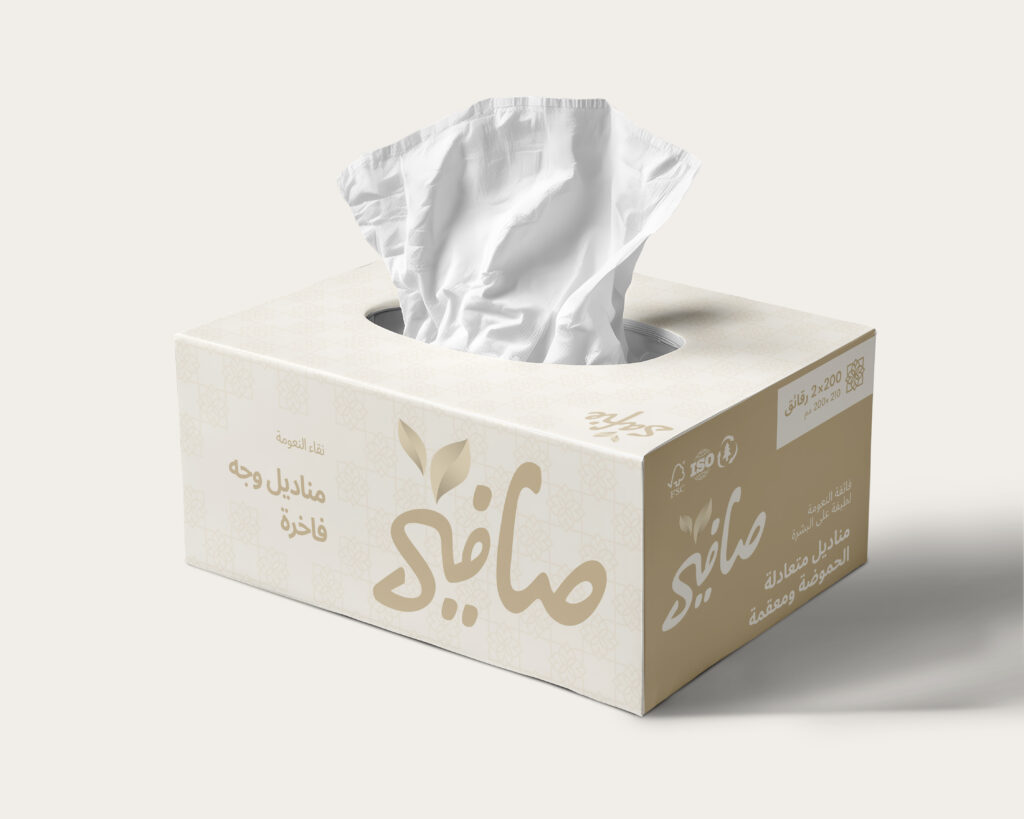
A family-owned group wanted to launch a premium facial-tissue brand in carton boxes called SAFIE, meaning “pure” in Arabic. The value proposition: softer feel than the mass brands (Fine, Masafi) and packaging that blends Nordic minimalism with subtle Gulf elegance.
Phase 1 – Idea Validation & Surveys
- Target: Western expatriates, Arab households, high-income Indian families in Dubai and Abu Dhabi.
- Method: 300 quick street-intercept surveys + 4 focus groups (mixed nationalities).
- Insight: Consumers felt existing tissues looked “too clinical”; they wanted something elegant enough for living-room coffee tables.
Phase 2 – Prototype Testing
- Two packaging styles produced in small batches.
- Blind softness test vs. leading competitor; SAFIE scored 15 % higher on perceived softness.
Phase 3 – Brand & Packaging
- Choose the “European white and light colors” variant, with grey waves and silver leaf motifs.
- Arabic logo calligraphed to convey purity; bilingual packaging approved by UAE Authorities.
Phase 4 – Market Entry Strategy
- Route-to-Market: Start with local retailers (Carrefour, Lulu, Waitrose, Spinneys), then move to online channels (Amazon, Noon etc.).
- Pricing: 10 % above market leader in mid-range segment, justified by premium positioning.
- Promotions: Ramadan bundle packs, influencer reviews from home-décor bloggers.
Phase 5 – Business Development
- Accurate ME introduced SAFIE to three top distributors, negotiated a fast-track listing, and supported import documentation.
- First purchase order confirmed within eight months of initial idea.
Outcome: Within just 3 months, SAFIE has transformed from an idea to a product, aiming to get a 1-2 % market share in the first year.
Why Companies Need Market-Entry Support in the UAE & KSA
Launching into unfamiliar territory can derail budgets quickly. Here are the top reasons clients engage us:
- Regulatory Surety – Avoid fines for mislabeling or late SFDA approvals.
- Cultural Alignment – Ensure product names, designs, and marketing resonate positively.
- Distributor Access – Leverage our network rather than cold-calling.
- Speed to Market – Reduce trial-and-error cycles; first mover often wins shelf space.
- ESG & Localization – UAE In-Country Value (ICV) requirements without stress.
Average Budget Expectations
Cost is always contextual—category complexity, urgency, number of SKUs—but to give you a comfort range:
- Idea Validation + Light Surveys could start low—think mid-five figures in dirhams—affordable even for lean start-ups.
- Full-stack market-entry (research, strategy, branding, distributor matchmaking) typically sits in the upper five to low six-figure dirham bracket—still modest compared with mislaunch costs.
- High-touch rollouts for FMCG or regulated categories (cosmetics, health supplements) may rise, but rarely exceed what a six-month in-house team would cost—without long-term overheads.
By structuring phases, we let clients scale investment as confidence builds rather than committing upfront to an oversized spend.
Summary: Why Accurate Middle East Is Your Best Launch Partner
Launching a new product into the UAE market should feel exciting—not overwhelming. Accurate Middle East delivers:
- Proven playbooks—100+ GCC market-entry projects across FMCG, manufacturing, tech, and wellness
- Local insight—bilingual teams, on-the-ground mystery shopping, and regulator liaisons
- End-to-end service—from idea validation to in-store activation, with zero coordination gaps
- Transparent costs—modular pricing, no hidden mark-ups, quicker ROI
Ready to transform your concept into GCC shelf reality? Drop our team a note at team@meaccurate.com, or reach out to us in Whatsapp and schedule a free 30-minute consultation. Within days, you’ll have a clear, data-driven roadmap toward a successful product launch in UAE—from first ideation to sustained sales growth.
Frequently Asked Questions
The most effective approach combines market validation, regulatory assessment, and a clear go-to-market strategy. Companies typically start with demand analysis, competitor benchmarking, and pricing validation before selecting entry channels such as distributors, direct sales, or partnerships.
Not always. Depending on the business activity and structure, companies can operate through mainland entities, free zones, or distributors. However, in many sectors, especially B2B, working with a local distributor or commercial partner accelerates market access and reduces entry risk.
Market entry timelines vary, but most product launches take 2 to 6 months, depending on regulatory approvals, partner selection, and operational setup. Highly regulated sectors such as healthcare or food may require additional time for product registration.
Regulatory requirements depend on the product category. Typically, companies must comply with product registration, labeling standards, import regulations, and certification requirements issued by UAE authorities. In sectors like medical devices or cosmetics, approvals can be mandatory before market entry.
Demand is assessed through a combination of market sizing, customer interviews, competitor analysis, and pricing research. Advanced approaches include primary research (B2B interviews or surveys) to validate real purchase intent and identify target segments.
Common challenges include high competition, pricing pressure, distributor dependency, and regulatory complexity. Many companies also underestimate the importance of local market dynamics, relationship-driven sales, and positioning strategy.
The UAE is often used as a regional entry hub due to its infrastructure, business environment, and access to international markets. Many companies start in the UAE and expand later into Saudi Arabia and other GCC countries once the model is validated.
Pricing is critical. The UAE market is highly competitive and transparent, requiring a well-calibrated pricing strategy aligned with positioning, target segment, and distribution margins. Incorrect pricing is one of the most common reasons for failed market entry.
Distributors play a key role in market access, client relationships, logistics, and sales execution. Selecting the right partner requires evaluating their portfolio, coverage, pricing control, and commercial incentives.
Yes. Many companies start with a pilot launch, limited distribution, or targeted customer validation before scaling. This reduces risk and allows refinement of pricing, positioning, and channel strategy based on real market feedback.
Costs vary widely depending on the product and strategy, but typically include company setup, regulatory approvals, marketing, and distribution costs. A structured feasibility study helps define realistic investment levels and expected returns.
High-potential sectors include construction materials, healthcare products, food & beverage, consumer goods, and technology solutions. However, success depends more on product-market fit and execution strategy than on the sector itself.


