
Dubai’s boutique fitness sector looks like an obvious growth market from the outside. Rising population, sustained spending on wellness, a demographic skewed toward working-age professionals with disposable income, residential communities purpose-built around active lifestyles. The opportunity reads well on paper.
What the numbers don’t immediately show is how quickly the competitive landscape has tightened, how fast customer expectations have moved, and how many boutique fitness concepts have launched in Dubai over the past five years with a beautiful fit-out, a credible concept, and insufficient commercial preparation — and then quietly struggled to hit the membership numbers their financial model assumed.
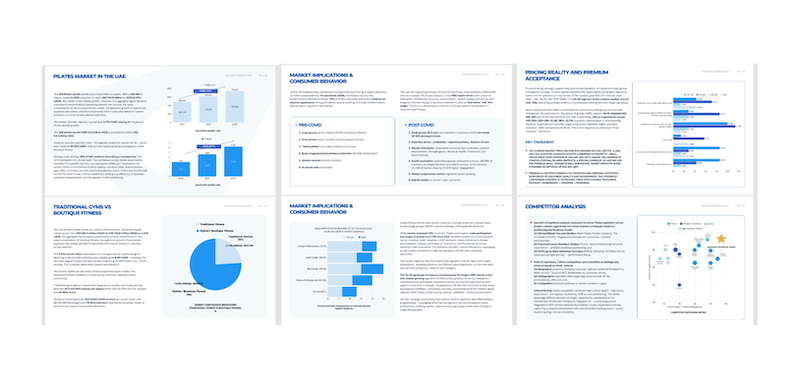
Feasibility study and business plan pilates studio
Reformer Pilates followed the same pattern. The category grew rapidly. Early movers built strong brands and loyal communities. New entrants arrived — some well-positioned, many replicating what already existed and expecting that quality alone would draw clients away from established studios. It rarely does.
Investment Decisions Supported by This Research
The project was designed to help the client answer several critical investment questions before committing capital:
- Should the studio proceed as originally planned?
- Which Dubai location offers the strongest commercial potential?
- What pricing strategy will maximise profitability?
- Which customer segments should be prioritised?
- How can the studio differentiate itself from existing competitors?
- What level of investment is required to achieve sustainable returns?
| Project Snapshot | |
| Industry | Boutique Fitness & Wellness |
| Location | Dubai, UAE |
| Business Challenge | Assess whether a premium Pilates studio concept could achieve sustainable commercial returns before investment. |
| Research Objective | Validate demand, positioning, pricing, location and financial feasibility. |
| Methodology | Market Research, Competitor Analysis, Mystery Shopping, Customer Survey, Focus Groups, Financial Modelling |
| Research Scope | Market assessment, location analysis, pricing strategy, business plan and investor pitch deck |
| Business Outcome | Validated investment opportunity, recommended location, pricing strategy and implementation roadmap |
An investor approaching us about opening a premium Pilates studio in Dubai was clear-eyed about this. They were not asking whether the market was growing. They accepted that it was. The question they needed answered was narrower and considerably more important: whether a specific concept, in a specific location, priced in a specific way, could generate returns that justified the capital required to launch it. Before signing a lease, purchasing equipment, or hiring instructors, they wanted evidence. Not a market report, but evidence. The first step was reviewing the requirements published by the Dubai Department of Economy & Tourism (DET).
The engagement we designed was structured as a complete commercial validation — market research feeding directly into competitive intelligence, customer insight informing positioning and pricing, financial modelling built from the ground up on verified assumptions rather than industry benchmarks. Every phase built on what came before. The result was a single, internally consistent picture of the opportunity and what it would actually take to capture it.
The engagement covered:
- Market research and demand analysis
- Competitive benchmarking across Dubai boutique fitness operators
- Mystery shopping and business intelligence
- Customer surveys and moderated focus groups
- Customer profiling and market gap analysis
- Location assessment across target communities
- Pricing strategy
- Feasibility study
- Financial modelling (three scenarios)
- Business plan development
- Investor pitch deck
- Market entry recommendations
Research Methodology
Before committing to a long-term lease, investing in premium equipment, or building a new fitness brand, the client needed independent evidence that the concept was commercially viable. To answer this question, we combined quantitative and qualitative market research with competitive intelligence, location assessment, and financial modelling. Each stage of the project was designed to validate a different commercial assumption, ensuring that the final business plan and investment model were built on verified market evidence rather than industry averages or optimistic projections.
| Research Activity | Business Purpose |
|---|---|
| Market Research | Validate demand |
| Competitor Benchmarking | Identify positioning opportunities |
| Mystery Shopping | Evaluate customer experience |
| Consumer Survey | Measure customer preferences |
| Focus Groups | Understand motivations |
| Location Assessment | Select optimal catchment area |
| Financial Modelling | Evaluate investment viability |
| Business Plan | Support implementation |
The Research Answered Six Commercial Questions
- Is demand for a premium Pilates studio strong enough to justify investment?
- Which customer segments offer the greatest commercial potential?
- How is the competitive landscape positioned today?
- What pricing structure will the target market accept?
- Which Dubai communities offer the strongest long-term opportunity?
- Under what financial assumptions does the investment become commercially viable?
Starting with the market, not the competition
The instinct in most feasibility projects is to begin by looking at competitors. We start one step earlier.
Before evaluating individual studios, it is necessary to understand the direction of the market they operate in. A competitive analysis conducted in isolation can identify who is winning today without revealing whether the category itself is expanding, plateauing, or approaching saturation. These three conditions call for entirely different strategies, and conflating them is one of the more common ways that otherwise well-designed business concepts enter the market at the wrong moment with the wrong positioning.
The market assessment examined Dubai’s boutique fitness and wellness sector against population growth trajectories, residential development pipeline, income distribution across target communities, consumer spending patterns on wellness and preventive health, and the lifestyle trends shaping demand for premium fitness services among the resident expat and Emirati populations. Dubai in 2025 is a different market from Dubai in 2020. Post-pandemic health consciousness, a continued influx of high-income residents, and an increasingly health-literate professional class have altered the demand landscape in ways that aggregate sector reports do not capture at a level of granularity useful for an investment decision.
The conclusion from this phase was not simply that the market was growing. It was that specific segments within it were growing faster than others, that certain communities represented meaningfully stronger concentrations of the target customer, and that the gap between what premium clients wanted and what existing operators provided had not fully closed. That gap was where the commercial opportunity sat — and defining it precisely was what the rest of the engagement was built around.
Competitive intelligence beyond the pricing spreadsheet
Most competitive analyses in boutique fitness produce a table: studio names, locations, class pricing, formats, capacity. It is a starting point. It is not intelligence.
The competitive benchmarking here covered Pilates studios and premium boutique fitness operators across Dubai, assessed against a consistent framework that extended well beyond what is publicly visible. Instructor credentials and training backgrounds, community-building practices, membership flexibility, digital presence, customer review sentiment over time, and the relationship between each operator’s pricing and their perceived value proposition — all evaluated, all compared.
The more revealing component was the mystery shopping programme. Our consultants approached selected studios as prospective clients, moving through the full customer experience from first enquiry through to membership consultation. Response times, the quality of the initial conversation, how studios handled pricing discussions, the gap between their online brand presentation and what the actual experience delivered — these are things you cannot learn from Instagram or a competitor’s website. They are also frequently where businesses lose clients they should have converted.
One pattern that emerged consistently: the strongest performers in Dubai’s premium fitness market were not winning on price. They were winning on instructor credibility, the community they had built around their brand, and the quality of the ongoing relationship between client and coach. Lower-priced operators were serving a different customer entirely. Between these two groups sat several studios with unclear positioning — not premium enough to justify their pricing, not accessible enough to compete on value. That is a structurally weak position in any market, and it was creating genuine space for a well-defined new entrant with the discipline to hold a clear position.
What customers actually said
Investor assumptions about what customers value are frequently wrong in ways that become expensive after launch. In boutique fitness, location is commonly cited as the deciding factor. When you study actual customer behaviour — where they travel to, how far they drive, what they pay at their current studio — a different picture often emerges.
Customer surveys and moderated focus groups with existing and prospective Pilates users across Dubai addressed the decision-making process directly. Not “do you practise Pilates” but “what determined where you train, what would make you change studios, and what would justify paying more than you currently do.”

Pilates Dubai UAE market research and feasibility study
Instructor expertise returned as the dominant factor, consistently ahead of location and ahead of price. Customers across multiple segments expressed clear willingness to travel further — sometimes significantly further — for a coach they trusted and a coaching relationship that delivered results. Location mattered, but it was not the ceiling most operators assumed it to be. This has direct implications for where a new studio should open and how it should build its founding team.
Membership flexibility was the second major theme. Appetite for rigid annual contracts had weakened. Clients increasingly wanted structures that accommodated how their lives actually work — frequent travel, variable schedules, changes in personal circumstances — rather than penalising them for not attending on a fixed cadence. This is a product design insight, not just a pricing one. It shapes how the business is operationally structured from day one.
These findings had direct consequences for the recommended membership architecture, pricing tiers, and the instructor profile the studio would need to recruit to make its positioning credible in the market it was targeting.
Key Customer Insights
Our primary research identified several consistent themes influencing studio selection and membership decisions:
- Instructor expertise was the strongest driver of studio choice.
- Personal trust and coaching quality outweighed proximity for many customers.
- Flexible membership options were preferred over long-term annual contracts.
- Premium pricing was acceptable when supported by a clear value proposition.
- Community and client experience played a significant role in customer retention and referrals.
Location as a commercial decision
A studio in the right community in the wrong location will underperform. A studio in the right location in the wrong community will underperform for different reasons. They are not the same problem, and treating them as interchangeable is a common mistake in boutique fitness planning.
Location analysis compared several Dubai communities against the target customer profile established during the research phase — assessing not just demographics and residential density but existing competitive concentration, accessibility and parking, surrounding businesses that would attract or deter the target client, planned residential developments that would alter the catchment within the studio’s first operating years, and the relationship between current rental costs and the revenue potential achievable at each site given the proposed price positioning.
Some locations offered strong demographics in communities already well-served by boutique fitness operators. Others offered lower costs but insufficient concentrations of clients willing to pay the price point the business model required. The recommended location was not the most obvious choice. It was the choice most tightly aligned with the specific concept, the customer profile the research had defined, and the financial model being built around them.
Financial modelling on verified assumptions
A financial model is only as reliable as the assumptions it runs on. Models built from generic sector benchmarks or developer-provided projections routinely overstate early-stage revenue, understate operating costs, and position investors for significant variance from forecast in the first year of operation.
What the Financial Model Evaluated
The financial model assessed the commercial viability of the proposed Pilates studio under multiple operating scenarios, including:
- Initial capital investment and funding requirements
- Membership growth and revenue projections
- Pricing strategy and profitability
- Staffing and operating costs
- Cash flow and working capital requirements
- Break-even timing
- Return on investment under conservative, base-case, and optimistic scenarios
- Sensitivity to changes in key commercial assumptions
The financial model here was constructed from the ground up using inputs derived directly from the research: verified competitive pricing ranges, realistic membership growth curves based on benchmarks from comparable Dubai operators, staffing costs built around the specific instructor profile the positioning required, and operating cost estimates grounded in current Dubai market conditions. Three scenarios — conservative, base, and optimistic — gave the client a clear view of the range of outcomes they were preparing for, which variables carried the most leverage over profitability, and where the financial model was most sensitive to changes in the market. Break-even timing, total capital requirements, cash flow through the pre-profitability period, and the return profile under each scenario were all modelled explicitly and tied back to the commercial assumptions the research had validated.
From analysis to execution
The financial model and market findings came together in a business plan written for operational use, not presentation. Organisational structure, staffing and recruitment approach, DHA licensing requirements, launch marketing strategy, and the operational procedures required to deliver the experience the positioning promised — all addressed in a document the client could use to run the business, not simply describe it.
An investor-ready pitch deck summarised the commercial case concisely for conversations with financial partners or co-investors. The engagement closed with market entry recommendations and partner identification — the supplier relationships, fit-out specialists, and commercial connections the client would need in place before opening day.
The investor came with a concept and a conviction. They left with a commercial case that had been tested, stress-tested, and validated from the ground up — and a clear path from decision to launch.
Project Deliverables
By the end of the engagement, the client received:
- Market demand assessment
- Competitive benchmarking and mystery shopping findings
- Customer segmentation and profiling
- Location recommendation with commercial rationale
- Pricing strategy
- Three-scenario financial model
- Operational business plan
- Investor-ready pitch deck
- Market entry recommendations
Planning a new investment or business concept in the UAE?
The distance between a promising idea and a commercially sound investment decision is almost always determined by the quality of the research and analysis between them.
Reach us on WhatsApp or call +971 50 559 5603 — we respond quickly and can turn around an initial scoping proposal within hours. For feasibility study and market research projects, complete our project brief form and receive a tailored proposal within 24 hours.


