
Last Updated: 09.08.2026
Assessing Commercial, Operational and Financial Viability in Saudi Arabia
Entering, launching or expanding a business in Saudi Arabia requires more than a promising concept or high-level market data. A professional feasibility study in Saudi Arabia tests whether the proposed project is commercially viable, operationally achievable and financially sustainable under actual Saudi market conditions. This includes market demand, competition and pricing, regulatory requirements, operating costs, investment requirements and financial returns. This guide explains how feasibility studies are conducted in Saudi Arabia, what they should include, typical costs and timelines, and how Accurate Middle East supports investors and companies evaluating projects across Riyadh, Jeddah and the wider KSA market.
Feasibility Study in Saudi Arabia
What a feasibility study in Saudi Arabia actually is
A feasibility study is a structured decision document that tests whether a business idea, expansion plan or investment can operate commercially, legally, operationally and financially under actual Saudi market conditions — not theoretical assumptions.
A business feasibility study goes beyond market size and growth figures. It connects real demand, customer behaviour, competition, pricing, regulatory requirements, operating costs, staffing, capital requirements and expected financial returns into one integrated decision framework.
The purpose is not simply to demonstrate that a market opportunity exists. A professional feasibility study should answer a much more important question: should capital be deployed in this project, under these conditions, at this scale and at this time?
For founders, investors and corporate decision-makers, the result should provide a clear basis for a go, revise or no-go decision before significant capital is committed.
When Do You Need a Feasibility Study while Entering a New GCC Market?
A feasibility study becomes particularly important when the investment decision involves significant capital, regulatory approvals, external financing or uncertainty around local demand.
Typical decision triggers
- First-time market entry into KSA
- Capital-intensive projects (manufacturing, healthcare, logistics, education, hospitality)
- Licensing-dependent activities requiring sector approvals
- Joint ventures with local partners
- Expansion beyond pilot or soft-launch phase
- Bank financing or investor capital raising
In practice, feasibility study companies in Saudi Arabia see demand peak before land is leased, staff are hired, or legal entities are finalized. Once fixed costs start accumulating, optionality disappears.
What Makes the Saudi Market Different?
Saudi Arabia does not behave like a simplified extension of the UAE or other GCC markets. Assumptions that work in Dubai frequently fail in Riyadh, Jeddah, or secondary cities.
Saudi-specific factors tested in a feasibility study
- market demand differences between Riyadh, Jeddah, the Eastern Province and secondary cities;
sector-specific licensing and approval requirements; - Saudization and workforce requirements
- government and semi-government procurement dynamics;
- local supply-chain and import dependencies;
- location, rent, logistics and operating-cost differences;
- potential incentives or financing programmes relevant to the project.
The exact feasibility framework therefore depends on the sector: a manufacturing project may require detailed CAPEX, production, industrial-location and supply-chain analysis, while healthcare, education, hospitality or consumer projects require different regulatory, demand and operating assumptions. A feasibility study KSA must reflect these dynamics. Imported benchmarks without local validation lead to distorted IRR calculations and false confidence.
How a Feasibility Study in Saudi Arabia Is Conducted
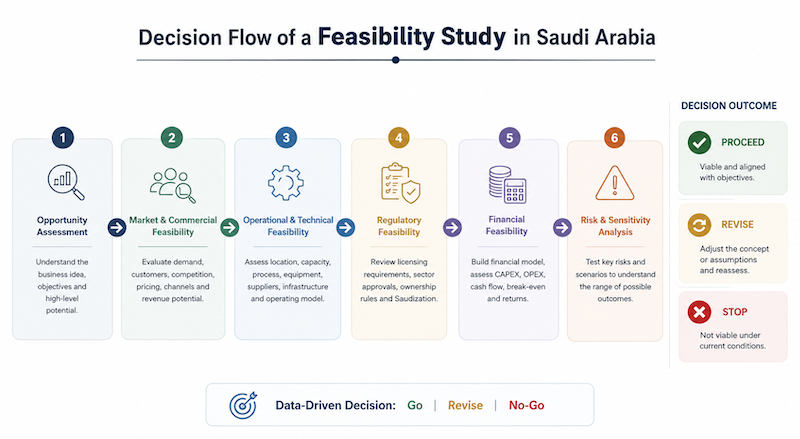
A professional feasibility study in Saudi Arabia should test the project from four connected perspectives: market and commercial viability, technical and operational feasibility, regulatory requirements, and financial sustainability. The objective is not to collect as much data as possible, but to validate the assumptions that will determine whether the investment succeeds or fails.
Phase 1: Market and Commercial Feasibility
The first phase tests whether sufficient demand exists for the proposed product, service or project under actual Saudi market conditions.
This typically includes:
- Market size and growth assessment where relevant
- Target customer and demand analysis
- Customer needs and buying behaviour
- Competitor and substitute analysis
- Pricing and willingness-to-pay validation
- Sales and distribution channel assessment
- Geographic differences between Riyadh, Jeddah, the Eastern Province and other target locations
Published market data alone is rarely sufficient for an investment decision. Where required, Accurate Middle East validates critical assumptions through primary research, including customer interviews, expert interviews, competitor research, pricing checks and direct discussions with market participants.
The purpose of this phase is to determine not only whether a market exists, but whether there is a commercially realistic opportunity for the specific business model being considered.
Phase 2: Technical and Operational Feasibility
Once the commercial opportunity has been established, the next question is whether the proposed business can realistically be established and operated in Saudi Arabia.
Depending on the project, the assessment may cover:
- Location and premises requirements
- Equipment and infrastructure
- Production or service capacity
- Supplier availability and procurement
- Import and supply-chain dependencies
- Logistics and distribution
- Staffing requirements and availability
- Operating structure and key cost drivers
For manufacturing and other capital-intensive projects, this phase may require deeper analysis of facility requirements, production capacity, equipment, utilities, raw materials and logistics. For service businesses, the focus may instead be on premises, staffing, service capacity and operational efficiency.
Phase 3: Regulatory Feasibility
Regulatory requirements can materially affect both the cost and timing of a project in Saudi Arabia. They should therefore be assessed before the financial model is finalized rather than treated as a separate compliance exercise later.
The assessment may include:
- Appropriate legal and ownership structure
- Business licensing requirements
- Sector-specific approvals and permits
- Foreign investment considerations where applicable
- Saudization and workforce requirements
- Regulatory dependencies affecting project launch
- Indicative approval and implementation timelines
The exact regulatory pathway depends heavily on the sector and proposed activity. Healthcare, education, manufacturing, food, hospitality and other regulated industries can require substantially different approval processes and operating conditions.
Phase 4: Financial Feasibility and Sensitivity Analysis
The final phase translates the validated market, operational and regulatory assumptions into a financial model.
This typically includes:
- Revenue assumptions and sales scenarios
- Capital expenditure (CAPEX)
- Operating expenditure (OPEX)
- Staffing and operating costs
- Working capital requirements
- Cash-flow projections
- Break-even analysis
- Profitability and margin assessment
- ROI and IRR where appropriate
- Funding requirements
- Sensitivity and downside scenarios
The model should not be built around a single optimistic forecast. Key assumptions — such as pricing, sales volume, operating costs, launch delays or capital expenditure — should be stress-tested to understand how changes affect the project’s financial viability.
This is where market research and financial feasibility must connect. If customer interviews indicate lower price acceptance, competitor research reveals stronger pressure on margins, or regulatory analysis identifies a longer launch period, these findings should flow directly into the financial model.
The final objective is to establish whether the proposed project remains commercially and financially viable under realistic Saudi market conditions — and whether the appropriate decision is to proceed, revise the concept, change the scale or entry model, or not invest.
What Should a Feasibility Study in Saudi Arabia Include?
| Feasibility Area | What We Assess |
|---|---|
| Market feasibility | Demand, target customers, market size where relevant, competitors, pricing and buying behaviour |
| Commercial feasibility | Revenue potential, sales channels, positioning and realistic customer acquisition assumptions |
| Technical feasibility | Location, capacity, equipment, suppliers, infrastructure and operational requirements |
| Regulatory feasibility | Licensing pathway, ownership considerations, sector approvals and Saudization requirements |
| Financial feasibility | CAPEX, OPEX, revenue assumptions, working capital, cash flow, break-even and investment returns |
| Risk analysis | Demand, pricing, cost, regulatory and execution risks under alternative scenarios |
Key Project Deliverables
- Board-ready feasibility study report
- Integrated financial model with scenarios
- Key risks and mitigation pathways
- Clear go / revise / no-go conclusion
Case Example: Healthcare Market Entry in Saudi Arabia

Feasibility Study Company Saudi Arabia KSA Riyadh
Client context
A regional healthcare services operator with existing operations in the UAE was evaluating entry into Saudi Arabia through a multi-site outpatient model. The client had preliminary interest from local partners and access to capital but lacked clarity on real demand, regulatory sequencing, and financial viability under Saudi operating conditions.
The investment decision required board approval and external financing, making a feasibility study in Saudi Arabia mandatory before committing to leases, licensing, or partner agreements.
Decision challenge
The client faced several unresolved questions:
- Whether demand existed beyond headline healthcare growth figures
- Which cities could support the proposed service mix at sustainable pricing
- How Saudization and staffing costs would affect unit economics
- Whether the expansion should be phased, restructured, or paused
- The core risk was entering the market based on UAE benchmarks and overestimating speed to breakeven.
Scope of the feasibility study
Accurate Middle East conducted a full business feasibility study focused on decision validation rather than concept promotion. The scope included:
- Market demand assessment by city and service line
- Competitive and pricing analysis across public and private providers
- Regulatory and licensing pathway review
- Operating model testing, including staffing and Saudization impact
- Financial modeling with downside sensitivity scenarios
The feasibility study services were structured to support a go / revise / no-go decision rather than a predetermined outcome.
Key findings
The feasibility study in Saudi Arabia identified that:
- Demand was materially concentrated in two cities, not nationwide
- Price elasticity was higher than initially assumed for core services
- Staffing costs under Saudization materially reduced margins in the first 24 months
- A multi-site launch would significantly increase cash burn without accelerating payback
Under the original expansion plan, projected returns did not meet the client’s internal investment threshold.
How Much Does a Feasibility Study Cost in Saudi Arabia?
Professional fees depend primarily on the sector, complexity of primary research, regulatory requirements, technical analysis and depth of the financial model.
| Project Type | Timeline | Professional Fees (USD) |
|---|---|---|
| Light feasibility study | 3-4 weeks | 12,000 – 18,000 |
| Full feasibility study | 6-8 weeks | 20,000 – 35,000 |
| Complex or regulated sectors | 8-12 weeks | 35,000+ |
A relatively straightforward commercial project may require mainly market and financial validation, while manufacturing, healthcare, education, hospitality and other regulated or capital-intensive projects typically require deeper technical, regulatory and operating analysis.
How to Choose the Right Consultant
Choosing a feasibility study company in Saudi Arabia should depend on more than the format of the final report. A credible consultant should be able to demonstrate how market, commercial and financial assumptions will be validated rather than simply presenting secondary statistics.
- Saudi market research and primary-data capability;
- sector-specific experience;
- ability to validate pricing and demand directly with customers or market participants;
- understanding of relevant Saudi regulatory and operating requirements;
- financial modelling capability;
- transparent assumptions and sources;
- willingness to recommend go, revise or no-go.
Feasibility Studies Across Saudi Arabia
Location can materially change project feasibility. Riyadh may offer greater concentration of corporate and government demand, while Jeddah, the Eastern Province and secondary Saudi cities can present different customer profiles, competition, operating costs, logistics and sector opportunities. For this reason, location selection should be tested as part of the feasibility study rather than decided in advance.
Why Companies Choose Accurate Middle East
Accurate Middle East combines feasibility analysis with primary market research, allowing critical assumptions to be tested against real Saudi market conditions rather than relying only on published data.
Where required, we validate demand, pricing, competition and customer behaviour through interviews, competitor research and direct market evidence, and connect these findings to the financial model.
Our feasibility studies are built around the investment decision — providing a clear go, revise or no-go recommendation before significant capital is committed.
Common Mistakes to Avoid
Common mistakes include relying too heavily on published market data, applying UAE assumptions directly to Saudi Arabia, overlooking regional differences in demand, and underestimating staffing, Saudization and operating costs. These errors can materially distort revenue forecasts, investment requirements and expected returns.
Discuss Your Project with Our Team
If you are assessing market entry, expansion, or capital deployment in Saudi Arabia, a decision-grade feasibility study should be your starting point.
You can speak about your project with Ai advisor in WhatsApp. Alternatively, complete our feasibility study brief at the link or send us our task: team@meaccurate.com. We typically respond with a tailored scope and proposal within 24-48 hours.
Frequently Asked Questions
Professional fees typically depend on the sector, project complexity, primary research requirements and depth of financial modelling. At Accurate Middle East, lighter feasibility studies typically range from USD 12,000–18,000, full studies from USD 20,000–35,000, while complex or regulated projects may exceed USD 35,000.
A relatively straightforward feasibility study may take 3–4 weeks, while a full study typically requires 6–8 weeks. Complex projects involving extensive primary research, regulatory assessment or technical analysis may take 8–12 weeks.
A comprehensive study typically covers market demand, customers, competition and pricing; technical and operational requirements; licensing and regulatory considerations; CAPEX and OPEX; revenue and cash-flow projections; break-even analysis; and financial sensitivity scenarios.
Not every business requires a formal feasibility study. It becomes particularly important when the project involves significant investment, external financing, regulatory approvals, uncertain demand or a business model that has not yet been validated under Saudi market conditions.
Yes, but the required structure and level of detail depend on the investor, lender or financing institution. If external financing is the objective, the feasibility study and financial model should be designed around the specific information and assessment requirements of the intended decision-maker.
Market research examines the market, customers, competitors, demand and pricing. A feasibility study goes further by combining market evidence with operational, regulatory and financial analysis to determine whether the proposed project is commercially viable and whether the investment should proceed.


