
Market Analysis, Investment Assessment, and Market Entry Strategy.
Client Context and Investment Objective
A regional manufacturing group approached Accurate Middle East with the objective of assessing the viability of establishing a paper and packaging production facility in the UAE. The investment was being considered as part of a broader expansion strategy into high-demand industrial segments within the GCC, with a focus on long-term positioning rather than short-term market entry.
The UAE has become one of the most structurally attractive manufacturing hubs in the GCC, particularly for industries linked to trade, logistics, and downstream consumption, supported by increasing manufacturing sector contribution within the broader economy. Among these, paper and packaging manufacturing sits at the intersection of retail, e-commerce, food production, and industrial supply chains — all of which have shown consistent expansion across the Emirates.
At the same time, the market is not as straightforward as demand growth alone might suggest. A significant share of paper and packaging products in the UAE continues to be import-driven, with cost competitiveness, raw material sourcing, and scale economics playing a decisive role in determining whether local production is viable.
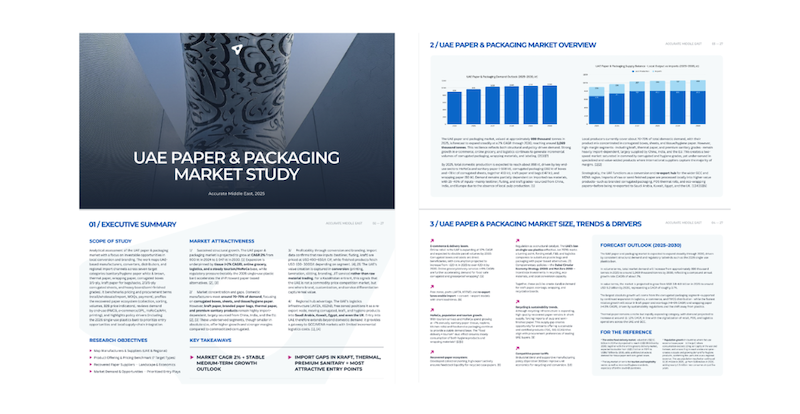
Paper & Packaging Manufacturing Feasibility Study in the UAE
Against this backdrop, a regional manufacturing group approached Accurate Middle East to assess whether establishing a paper and packaging production facility in the UAE would be commercially and operationally justified — not only from a market demand perspective, but in terms of full investment feasibility.
This case represents a comprehensive feasibility study in the UAE, combining market research, competitive analysis, cost benchmarking, and financial modeling to support a high-stakes industrial investment decision.
Decision Problem: Manufacturing Feasibility in the UAE
The client was not looking for a high-level market overview. The core question was significantly more complex:
Does it make strategic and financial sense to invest in a paper and packaging manufacturing facility in the UAE, and under what conditions would such an investment be viable?
This required moving beyond standard market research in the UAE into a structured manufacturing feasibility study, addressing several layers of uncertainty:
- Is local demand sufficient and stable across key B2B segments?
- Which product categories offer realistic entry points for a new manufacturer?
- How strong is import dependency, and where are the substitution opportunities?
- Can a UAE-based facility compete on cost with imported products?
- What are the operational constraints — land, utilities, labor, logistics?
- What scale is required to achieve acceptable margins?
- What are the risks under different pricing and demand scenarios?
In essence, the client needed not just data, but a decision framework — one that would allow them to confidently proceed, adjust, or decline the investment.
Paper & Packaging Market Overview in the UAE
Demand Drivers Across Key B2B Segments
The paper and packaging market in the UAE is shaped by a combination of strong demand drivers and structural constraints.
On the demand side, growth is supported by:
- Expansion of F&B and retail sectors, requiring consistent packaging supply
- Rapid growth of e-commerce and last-mile logistics, increasing demand for corrugated packaging
- Industrial consumption across manufacturing, construction, and exports
- Regulatory and sustainability trends encouraging shifts in packaging materials
- Growth Trends in Packaging and Industrial Consumption
However, market dynamics are heavily influenced by import reliance. A large portion of packaging materials — particularly in specialized segments — is sourced from international suppliers, primarily due to lower production costs in high-scale manufacturing markets, established supplier relationships, and price sensitivity in bulk B2B procurement.
This creates a dual reality where demand exists, but local production must compete against optimized global supply chains.
From a market analysis UAE perspective, this means that demand alone does not guarantee feasibility. The real opportunity lies in identifying specific segments where local production can outperform imports.
What We Did: Market Analysis and Demand Assessment
Market Sizing and Demand Segmentation
We developed a bottom-up market model to estimate demand across key paper and packaging categories, including corrugated packaging, folding cartons, industrial paper products, and specialized packaging formats.
This involved triangulating trade data, industry consumption proxies, and B2B demand patterns across sectors such as retail, food production, and logistics.
Competitive Landscape and Import Dependency
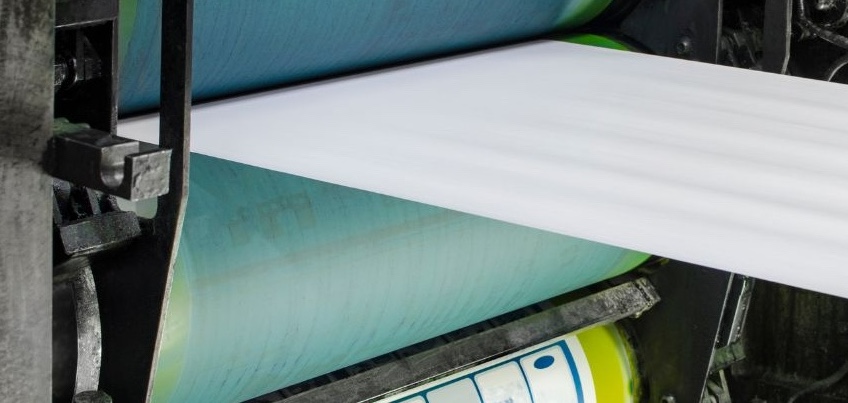
Local Manufacturers vs Imported Products
A detailed competitive analysis in the UAE was conducted, covering local manufacturers, capacity, positioning, and product range.
Price Benchmarking Across Supply Sources
We also analyzed import flows by product category and conducted pricing benchmarks across different supplier types, identifying where local production could realistically compete.
Cost Structure and Production Feasibility
Land, Utilities, and Operational Costs in the UAE
We assessed land and facility costs across different emirates, utilities, labor structure, and logistics to define a realistic operational baseline.
Raw Material Sourcing and Supply Chain Constraints
Raw material sourcing and supply chain dependencies were evaluated to understand cost pressures and operational risks.
Financial Model and Investment Viability
CAPEX Requirements for Manufacturing Setup
We developed a full financial model including capital expenditure for equipment, setup, and infrastructure.
Revenue Scenarios and Break-Even Analysis
The model included revenue projections, operating costs, scenario analysis, and ROI calculations, allowing the client to test different assumptions.
Outcome: Market Entry Strategy and Investment Decision
The outcome of the engagement was not a report — it was a clear investment position.
The client received:
- A validated market opportunity framework
- A defined market entry strategy
- A transparent cost and competitiveness model
- A financial feasibility assessment
- A structured go / no-go decision basis
As a result, the client was able to move forward with a structured, risk-adjusted investment approach.
Manufacturing Feasibility Studies in the UAE: Why They Matter
Many industrial projects appear attractive due to demand growth. However, without a deep feasibility assessment, critical risks remain hidden — including overestimation of demand, underestimation of competition, and misalignment of cost structures.
A properly structured feasibility study transforms market data into actionable investment decisions.
Start Your Feasibility Study in the UAE
If you are evaluating a manufacturing investment, expanding into the UAE, or assessing a new product line, the key question is not whether demand exists — but whether your specific business model can operate competitively within the market structure.
At Accurate Middle East, we specialize in market research, feasibility studies, and market entry strategy across the UAE and Saudi Arabia, supporting companies at critical investment and expansion stages.
To discuss your project or request a tailored proposal:
Contact us directly on WhatsApp
Call our UAE team: +971 50 599 5603
You can also request a callback or share your project details through our brief form.
We review each request individually and provide a structured, customized proposal within 24–48 hours, aligned with your objectives, scope, and investment stage.
Frequently Asked Questions
What does a manufacturing feasibility study in the UAE include?
A manufacturing feasibility study in the UAE usually includes market analysis, demand assessment, competitor benchmarking, cost structure evaluation, and financial modeling. It helps investors understand whether a specific industrial project can operate competitively in the local market.
How long does a feasibility study for a manufacturing project in the UAE take?
Most manufacturing feasibility studies in the UAE take between 4 and 8 weeks, depending on the complexity of the project, number of product categories, geographic scope, and depth of primary research required.
Why is market analysis important before setting up a factory in the UAE?
Market analysis helps determine whether demand is accessible, not only whether it exists. In industries such as paper and packaging, imported products may strongly influence pricing, margins, and the realistic opportunity for local production.
What industries usually require feasibility studies in the UAE?
Feasibility studies are commonly required for manufacturing, construction materials, food production, healthcare, industrial services, logistics, and other capital-intensive sectors where investment decisions depend on demand, regulation, cost, and competition.


