
Evidence That Holds Under Investment Scrutiny
Entering Saudi Arabia is rarely blocked by ambition. It is blocked by assumptions that have not been tested: where demand is genuinely accessible, how procurement decisions are made, and what pricing the market will actually accept from a new entrant. Market research in Saudi Arabia exists to close that gap before capital is committed, teams are hired, and contracts are signed.
Market Research in Saudi Arabia
The Kingdom’s commercial environment does not reward generic research. Published sector statistics describe national totals. They do not explain how demand is distributed across Riyadh, Jeddah, and the Eastern Province; how procurement structures differ between government-linked buyers and private sector operators; or what determines whether a foreign entrant gains traction or spends two years pursuing prospects already committed to existing suppliers.
What follows covers how market research is structured and applied in Saudi Arabia for market entry, investment decisions, and feasibility work — written for corporate strategy teams, founders, and investors who need findings they can defend internally and externally.
What Market Research in Saudi Arabia Actually Involves
In Saudi Arabia, market research is a structured process for validating demand, pricing logic, and competitive dynamics under local commercial and regulatory conditions. The questions that matter are specific: who buys, why they buy, who approves the decision, and what causes delays or prevents switching from an existing supplier.
When the inputs are grounded in evidence rather than assumption, strategy becomes easier to execute and financial models become harder to challenge — which matters significantly in a market where investment committees, lenders, and government approval bodies all scrutinize the demand assumptions behind a business case.
Why Market Research Is Essential Before Committing Capital
Saudi Arabia amplifies both upside and error. Under-researched entries tend to scale costs faster than revenues, while well-researched entries scale with controlled exposure. This is why experienced teams treat market research services as an input to investment governance, not marketing.
The Kingdom’s commercial reality is shaped by regional variation, centralized authority in many procurement settings, and requirements that can shift execution timelines. None of this is visible in headline market size figures, and all of it affects cash flow.
Typical reasons research is commissioned
- To validate whether demand is accessible, not only “present” on paper.
- To test pricing tolerance and discount expectations by buyer type.
- To understand competitor behavior beyond public messaging.
- To quantify timing risk: procurement cycles, approvals, and onboarding.
When to Commission Market Research in Saudi Arabia
In most serious projects, market research in KSA is commissioned at defined decision points. That is when the value is highest: when choices are still reversible and financial exposure is still controllable.
Decision moments where research has the highest impact:
- Before forming a local entity or committing to a partnership structure in KSA;
- Before submitting a feasibility study to investors, lenders, or an internal board;
- Before locking pricing, packaging, or distribution terms into contracts;
- Before committing marketing or operational budget to a specific region or segment.
For a broader overview of our research capabilities, see our market research services, covering custom research, primary research, competitor analysis, customer research and market intelligence across the GCC.
How Market Research Is Conducted in Saudi Arabia
Strong work starts with a commercial question, not a questionnaire. Methodology is designed around the specific decision being made — market entry, pricing, location selection, channel strategy, or investment sequencing. The research structure follows from the decision, not the other way around.
Step 1: Define the decision boundary
The first step is agreeing on what the research must prove or disprove. Without a clear decision boundary, outputs become descriptive and interpretation becomes subjective. A well-scoped project begins with two or three specific hypotheses — commercial assumptions the client is currently making that need to be validated or corrected.
Step 2: Map the market structure that drives outcomes
Saudi Arabia is not a single homogeneous market. Demand concentration, buyer profiles, and competitive dynamics vary materially between Riyadh, Jeddah, and the Eastern Province — and between government-linked procurement, private sector buyers, and mixed entities. This step establishes where accessible demand actually sits and what “realistic market penetration” means in practice for the specific business model.
Step 3: Triangulate evidence
- Primary research — structured interviews with buyers, procurement decision-makers, channel partners, and sector experts;
- Competitive intelligence — how suppliers actually win business, not how they describe themselves publicly;
- Secondary research — market sizing, regulatory framework, sector indicators, and trade data from credible institutional sources.
Step 4: Translate findings into strategy and financial inputs
This is where research earns its fee. Findings are converted into assumptions that can be modelled and stress-tested: demand scenarios tied to realistic access and timing, pricing corridors with margin sensitivity analysis, and competitive response assumptions that hold up under scrutiny. The deliverable is a clearer investment decision — not a longer report.
Demand in Saudi Arabia: Size Is Not the Same as Access
Saudi Arabia’s scale is real. The risk is treating national market size as commercially accessible demand. In most sectors, early-stage demand is concentrated in two or three regions — typically Riyadh, Jeddah, and the Eastern Province — and purchasing authority is more centralized than the organizational structure suggests. A national rollout plan built on top-down market size figures will almost always overestimate accessible revenue and underestimate the time required to reach it.
What demand analysis establishes:
- Which cities and regions generate the majority of realistic near-term demand;
- Which buyer types control budget and purchasing decisions — and who influences without deciding;
- What triggers adoption, switching, or delays in approval processes;
- What realistic market penetration looks like across a 12–36 month horizon.
When Saudi market research is done properly, the output is a sharper entry sequence — a defined starting point with specific conditions for expansion — rather than an ambitious national rollout plan that the first year of operations will quietly revise.
Pricing Reality: What Buyers Accept and What They Resist
Pricing mistakes in Saudi Arabia are expensive to correct. Repositioning a product or service after it has been introduced at the wrong price point typically requires renegotiation, repackaging, or a relationship reset with early clients — all of which consume time and credibility. The objective of pricing research is to define a defensible corridor before launch, not find the theoretically perfect number.
How pricing is validated in Saudi market research:
- Testing willingness to pay across buyer types — public sector, private sector, and hybrid entities behave differently;
- Identifying which specific value drivers justify premium positioning in practice, not in assumption;
- Mapping discount expectations by segment — and identifying where aggressive discounting signals weakness rather than flexibility.
A serious research team treats pricing as behavior, not survey preference. The result is cleaner financial modelling, fewer surprises at the contracting stage, and less dependence on discounting to generate early traction.
Competitive Dynamics: Why a Competitor List Is Not Enough
In Saudi Arabia, competitors frequently win for reasons that don’t appear in their marketing: procurement relationships built over years, compliance track records that reduce approvals risk, delivery reliability in a market where execution is harder than it looks, and familiarity with how government-linked buyers structure their decisions. Research that summarizes public positioning misses most of this.
What competitive research should produce:
- A clear picture of how existing suppliers actually win business — pricing, relationships, compliance positioning, and delivery factors
Which segments are actively defended and which are structurally underserved - Where switching costs are genuinely high and where clients would move if presented with a credible alternative
Saudi market research is not a catalogue of players. It is an explanation of how this specific market behaves commercially — and what that behavior means for positioning, sequencing, and realistic expectations for a new entrant.
How Market Research Connects to Feasibility and Business Planning
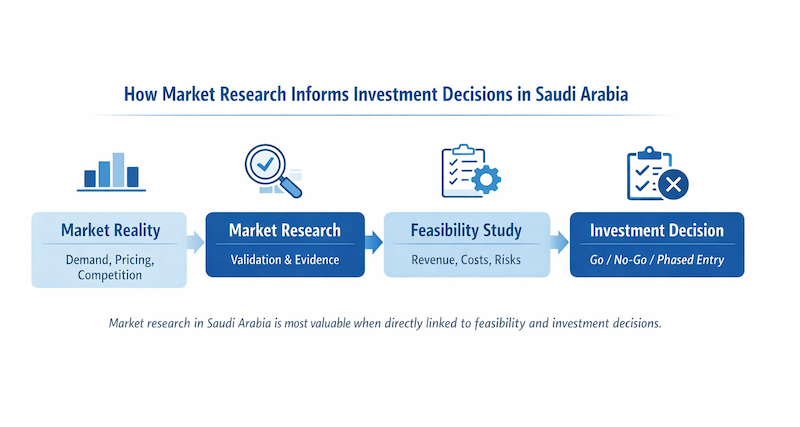
Market research is most valuable when its outputs feed directly into feasibility analysis and business planning — not when it sits as a standalone report that a strategy team then has to manually translate.
Research establishes the demand, pricing, and competitive evidence. Feasibility analysis converts that evidence into revenue scenarios, cost structures, and break-even timelines. Business planning turns the validated assumptions into an execution roadmap. When the three are structured as a connected sequence rather than separate projects, the output is a package that can be presented to investors, lenders, or internal boards without requiring extensive additional justification.
What research typically contributes to feasibility work
- Demand scenarios — segmented by region, buyer type, and realistic timing;
- Pricing corridors — with margin sensitivity under different competitive conditions;
- Competitive response assumptions — what incumbents are likely to do and how quickly.
Project Example
International Services Company — Saudi Arabia Market Entry
Challenge: An international services company was evaluating entry into Saudi Arabia. Initial projections assumed broad national demand, price parity with other GCC markets, and a rapid rollout plan across multiple regions. The business case required validation before internal investment approval.
Research: Structured interviews with procurement decision-makers across government-linked and private sector organisations, demand mapping by region, and pricing validation across buyer types. Analysis of procurement cycle timing and decision authority structures.

Market Research Companies in Saudi Arabia
Finding: Effective demand was concentrated in two regions, not distributed nationally. Pricing tolerance differed materially between government-linked buyers and private sector operators — a distinction the initial model had not accounted for. Decision authority was more centralized than the organizational structure suggested, which affected realistic sales cycle timelines.
Result: The client revised the entry sequence and adjusted the pricing model by buyer type. Early-stage revenue projections were lowered, but margin stability and cash-flow visibility improved significantly. The validated demand and pricing assumptions became the foundation of the feasibility study submitted for internal investment approval.
Cost of Market Research Services in Saudi Arabia
Decision-makers usually ask about cost early, and they should. In Saudi Arabia, the cost of market research depends less on page count and more on access requirements, senior involvement, and the level of defensibility required for investors or boards. The ranges below reflect typical engagement sizing for entry and investment decisions.
| Scope | Typical Use | Indicative Cost |
|---|---|---|
| Focused market assessment | Early validation, pricing logic | USD 8,000–15,000 |
| Full market research study | Market entry, feasibility input | USD 15,000–35,000 |
| Research + feasibility integration | Investment approval | Project-based |
Pricing is indicative. Final scope and investment are confirmed after a brief intake call. All projects are quoted individually — no standard packages.
Experienced market research firms price work based on the level of responsibility: producing conclusions that a management team can defend, and that can survive scrutiny in financial modelling and governance discussions.
Why Companies Choose Accurate Middle East for Saudi Market Research
Most research firms can produce a report on Saudi Arabia. The question is whether the findings are grounded in how the market actually behaves — or in how it appears from secondary data and general sector knowledge.
Accurate Middle East operates with an on-ground team and established access across Riyadh, Jeddah, and the Eastern Province. We conduct structured interviews with government-linked buyers, private sector procurement teams, and sector specialists — not just desk research assembled from published sources. This access matters in Saudi Arabia more than in most markets, because the gap between what organisations say publicly and how they make decisions commercially is wider here than in more transparent markets.
- On-ground research capability across Riyadh, Jeddah, and the Eastern Province;
- Direct access to government-linked buyers, private sector procurement, and sector specialists;
- Proprietary GCC panel of 50,000+ B2B and consumer respondents — reducing field timelines;
- Research structured to connect directly to feasibility analysis and investment documentation;
- Bilingual delivery — Arabic and English — for accurate primary data collection
- 100% custom scope — no templates, no pre-packaged Saudi sector reports.
Research methodology combines primary fieldwork with institutional secondary sources — including national statistics published by the KSA National Statistics, trade data, and sector-specific regulatory filings. Primary inputs take priority: secondary data provides the framework, fieldwork provides the evidence.
Every project is senior-led. The consultant who scopes the engagement leads the analysis and presents the conclusions — findings are not filtered through a junior team before reaching the client. For projects that require investment-grade outputs, this matters: the person defending the assumptions in a board or feasibility review is the same person who built them.
Planning a Business or Investment in Saudi Arabia?
Market research is often the first step, but the next decision depends on what the evidence shows. Accurate Middle East supports companies across the full Saudi investment and expansion process:
→ Feasibility Study in Saudi Arabia — test whether the opportunity is commercially and financially viable before committing capital.
→ Market Entry Strategy in Saudi Arabia — determine the right entry model, market priorities and implementation sequence.
→ Regulatory Analysis in Saudi Arabia — understand licensing, sector requirements and regulatory constraints before establishing operations.
→ Go-to-Market Strategy for B2B in Saudi Arabia — translate a validated opportunity into positioning, pricing, channels and sales execution.
→ Competitor Analysis in Saudi Arabia — understand how established competitors actually compete on pricing, positioning and market access.
Request a Market Research Proposal for Saudi Arabia
If you are preparing entry into Saudi Arabia or need independent evidence to support a feasibility study, request a tailored market research proposal from our team. You can talk to our AI assistant who can collect the key data about your task via WhatsApp. If you prefer a structured start, submit your project brief here: project brief form. We respond with scope and next steps, typically within one to two business day.
 | |
Author: | |
| Dr. Elena Zhukovskaya Senior Consultant, Partner | |
| 20+ years of experience in market research, business management, investor relations, and brand communications across the UAE, KSA, and GCC. Author of 50+ publications and a regular speaker at leading business events in the region. Linkedin profile |

Frequently Asked Questions
Timelines depend on scope. A focused Market Snapshot — one sector, demand validation, competitive scan — typically completes in 3–4 weeks. A full Sector Entry Research study runs 6–8 weeks. Projects that combine market research with feasibility analysis or financial modelling require 10–14 weeks. All timelines are confirmed at scoping stage and built around your decision deadline, not a standard delivery schedule.
Yes. Primary research — interviews, surveys, stakeholder consultations — is conducted in Arabic where required. This matters for B2B research in Saudi Arabia specifically: Arabic-language interviews with procurement teams and sector specialists produce more accurate and candid responses than English-language alternatives. Final deliverables are produced in English unless otherwise agreed.
Direct access to government-linked procurement teams, private sector buyers, and sector specialists across Riyadh, Jeddah, and the Eastern Province is part of our standard research capability in KSA — not an add-on. We maintain an established network of B2B contacts across construction, manufacturing, technology, healthcare, logistics, and financial services sectors. Where network access is insufficient, we use structured recruitment through our GCC panel of 50,000+ respondents.
Yes — and this is a common use case. Research outputs are structured to integrate directly with financial feasibility models, SAGIA documentation, and board-level investment decisions. If a feasibility study is the end objective, we scope the market research component to produce the specific demand, pricing, and competitive benchmarking data the feasibility model requires. This avoids duplication between research and feasibility phases.
Several practical differences affect methodology. Saudi Arabia has a more concentrated decision-making structure — purchasing authority in many sectors sits within government-linked entities or large family conglomerates, which requires different access and research design compared to UAE's more fragmented commercial market. Consumer research in KSA requires gender-stratified sampling in most categories. Regulatory structures differ significantly across sectors, particularly in healthcare, food, and financial services. Regional variation within KSA is also material: Riyadh, Jeddah, and the Eastern Province can behave as distinct sub-markets.
Yes. A significant share of Saudi-focused work relates directly to Vision 2030 priority sectors — tourism and hospitality, entertainment, healthcare, renewable energy, logistics, and manufacturing. For these sectors we combine primary fieldwork with analysis of regulatory developments, localisation requirements (Saudi Aramco IKTVA, NITAQAT), and demand patterns driven by government investment programmes. If your project sits within a Vision 2030 sector, tell us at intake — it shapes the research framework and the secondary sources we prioritise.
Yes. Research coverage includes Riyadh, Jeddah, Dammam and the Eastern Province, and secondary cities where relevant to the sector. For consumer and retail research in particular, regional variation in purchasing behaviour, brand awareness, and price sensitivity is significant and is captured in the research design rather than assumed to be uniform.
The process begins with a short intake call — typically 30 to 45 minutes. We use that conversation to understand your decision context, timeline, and what the research needs to answer. A scoped proposal with methodology, timeline, and investment follows within 48 hours. There is no obligation at that stage. Contact us at team@meaccurate.com.


