
Last Updated: 27 October 2026
In many UAE B2B markets, the information that matters most is not published anywhere.
A distributor may tell you that demand is growing, but margins are becoming difficult. A procurement manager may explain that price is not the real barrier — certification, credit terms or delivery reliability are. A technical specialist may tell you that the product your team plans to launch is simply not being specified by consultants or accepted by end users. None of this is visible in a market-size chart.

Expert Interviews UAE
This is why companies use expert interviews in the UAE: to understand how a market actually works before making a commercial decision.
At Accurate Middle East, expert interviews are usually designed around a specific management question. The objective may be to assess market entry potential, validate a feasibility study, understand distributor expectations, investigate procurement behaviour, test pricing assumptions or clarify why competitors are stronger in a particular segment.
The interview itself is only one part of the work. The real value comes from identifying the right people, asking the right questions and interpreting what their answers mean for the decision being made.
Expert interviews can be used independently, but more often they form part of a wider primary research project in the UAE, feasibility study or market-entry assignment.
What Is an Expert Interview?
An expert interview is a structured or semi-structured conversation with someone who has direct, relevant knowledge of a market, industry, purchasing process, technical issue or commercial practice.
That sounds straightforward, but there is an important distinction: seniority is not the same as relevance.
One of the most common mistakes we see is a request for “senior experts” without defining what those experts actually need to know. A CEO may understand the market at a strategic level, but a procurement manager may know much more about supplier selection. A distributor may understand margins and channel economics better than an industry consultant. A technical specialist may know exactly why one specification is accepted and another is rejected.
We therefore start with the business question, not with the job title.
If the client wants to understand distributor economics, we need distributors. If the question is product acceptance, we may need buyers, technical specialists or consultants. If the challenge is market entry, several stakeholder groups may need to be interviewed because each group sees a different part of the market.
What Companies Usually Want to Learn
Expert interviews are most useful when desk research gives you the outline of a market but not the answer to the commercial question.
Typical questions include:
- What is actually driving demand in this segment?
- Which buyer groups are growing and which are not?
- How are suppliers shortlisted?
- What margins do distributors expect?
- Which commercial terms are considered normal?
- What makes buyers switch suppliers?
- Which technical specifications really matter?
- What barriers are most difficult for new entrants?
- How are competitors positioned beyond what is visible online?
- What pricing is realistic?
- Where are the gaps or unmet needs?
- Which parts of the market are attractive enough to justify further investment?
These are often the questions that determine whether a market-entry strategy or feasibility model is realistic.
Who Do We Need to Speak To?
There is rarely one perfect respondent type.
For some projects, the most useful people are distributors and wholesalers. For others, they are procurement managers, technical decision-makers, business owners or sector specialists.
Depending on the research objective, we may interview:
- distributors and wholesalers;
- procurement and purchasing managers;
- business owners and senior executives;
- category or commercial managers;
- technical specialists and engineers;
- contractors and consultants;
- healthcare administrators and sector professionals;
- retail operators;
- suppliers and manufacturers;
- former industry executives;
- specialist consultants or analysts;
- regulatory or government stakeholders where appropriate and accessible.
In specialist B2B research, respondent quality usually matters more than interview volume.
Five strong interviews can sometimes reveal a flawed assumption very quickly. Ten interviews with the wrong stakeholder group may still leave the main question unanswered.
This is why respondent selection is one of the most important parts of the research design.
What Expert Interviews Reveal That Desk Research Misses
Desk research is essential. It helps establish the market structure, competitors, regulations, published data and known trends. But there is a limit to what secondary data can tell you.
A report may show that the construction sector is expanding. It may not tell you which product specifications are becoming more common, what consultants are willing to approve, what credit terms distributors expect or why one supplier consistently wins tenders.

Expert Interviews UAE
A database may identify pharmaceutical distributors. It does not necessarily tell you which of them genuinely have access to the right buyers or which categories they consider overcrowded.
Public automotive pricing may show a list price, but not the real commercial offer after discounts, financing, service packages and dealer negotiation. This is where expert interviews add value.
They help explain the “why” behind the published data and test whether the assumptions built from desk research hold up in the real market. The strongest conclusions usually come when several independent respondents point in the same direction and their answers are consistent with other evidence.
Expert Interviews vs B2B Customer Interviews
The two methods overlap, but they are not identical.
Expert interviews usually look outward at the market: structure, competition, regulation, distribution, commercial norms and sector trends.
B2B customer interviews look more directly at the buyer: how they select suppliers, what they value, why they switch, what frustrates them and how they make purchasing decisions.
The same person can sometimes provide both types of insight. A procurement director, for example, may explain both the wider market and the internal buying process.
If the main objective is to understand customers rather than the broader sector, see our B2B Market Research UAE services.
Expert Interviews vs Surveys vs Desk Research
No single method answers every question well.
| Research Method | Best Used For | Typical Output |
|---|---|---|
| Expert Interviews | Market structure, industry practices, competition, specialist knowledge | Deep qualitative market intelligence |
| B2B Customer Interviews | Buyer needs, supplier selection, procurement behaviour | Detailed customer insight |
| Surveys | Measuring patterns across a larger sample | Quantitative evidence |
| Desk Research | Published data, market background, company and regulatory information | Secondary market intelligence |
In practice, these methods often work best together.
Expert interviews may identify issues that later need to be measured through a survey. Or they may be used after desk research to validate assumptions before management commits to a financial model or market-entry plan.
How We Approach Expert Interviews
We normally start with the decision, not the respondent list.
If the client is assessing whether local manufacturing makes sense, we may need buyers, distributors and technical specialists. If the challenge is distributor selection, the research may focus on channel structure, margin expectations, sales coverage and supplier support. If the question is pricing, we may need both buyers and intermediaries because the price visible to the end customer is not always the same as the economics of the channel.
Once the decision is clear, we define the respondent profiles and build the interview guide around specific hypotheses.
The guide is not meant to be a rigid questionnaire. It gives structure to the discussion while allowing the interviewer to follow an unexpected point when it becomes commercially important.
This flexibility matters. Some of the most useful findings emerge when a respondent challenges the original assumption.
After fieldwork, the answers are compared across interviews. We look for recurring themes, contradictions and areas where additional validation may be required. One respondent’s opinion is not automatically treated as a market fact.
The final objective is to determine what the interviews collectively mean for the client’s decision.
Expert Recruitment Is Often the Hardest Part
Recruiting the right people can require more work than conducting the interviews themselves.
A respondent may have an impressive title but limited exposure to the issue being researched. Another person may be less senior but deeply involved in the actual purchasing, technical or operational process.
Depending on the project, we may qualify respondents based on:
- current role;
- company type;
- industry experience;
- geographic coverage;
- purchasing responsibility;
- technical knowledge;
- relevance to the exact research question;
- recency of experience.
Experts may be identified through professional outreach, established networks, specialist recruiters and research partners, depending on the sector and respondent profile. This is especially important in narrow B2B markets where the number of genuinely relevant experts is limited.
How Many Expert Interviews Are Enough?
There is no universal answer.
A small exploratory study may need only a few carefully selected interviews to identify the main market issues. A more complex assignment may require several stakeholder groups or separate interviews across different Emirates or GCC countries.
The relevant question is not simply “How many interviews should we buy?”
It is: “How many independent perspectives do we need before we can make this decision with reasonable confidence?”
In some projects, five strong interviews are enough to expose a weak assumption. In others, ten interviews still leave gaps because the sample has not covered the right stakeholder groups.
The UAE Context Matters
The UAE is compact geographically, but many B2B markets are not simple.
Some sectors are led by multinational procurement teams. Others depend heavily on local distributors or specialist intermediaries. Dubai, Abu Dhabi and the Northern Emirates may also have different buyer structures, competitive intensity and commercial expectations.
Free-zone companies, mainland businesses, government-linked entities and private-sector buyers can follow different procurement and operating models.
For official information on business setup and operating structures, companies should also refer to the UAE Government business portal.
For research purposes, the important point is that “UAE experience” alone is not enough. Respondents need to reflect the actual market structure of the sector being studied.
For companies entering the country, expert interviews can form part of a broader UAE Market Entry Strategy, helping validate assumptions around pricing, positioning, channels and partner selection.
Where Expert Interviews Fit Into a Larger Study
Expert interviews are often most valuable when they sit inside a broader piece of research.
A manufacturer assessing a UAE production facility may use interviews to validate demand, technical requirements, competitor supply, buyer interest and channel expectations. These findings can then support the assumptions used in the feasibility model.
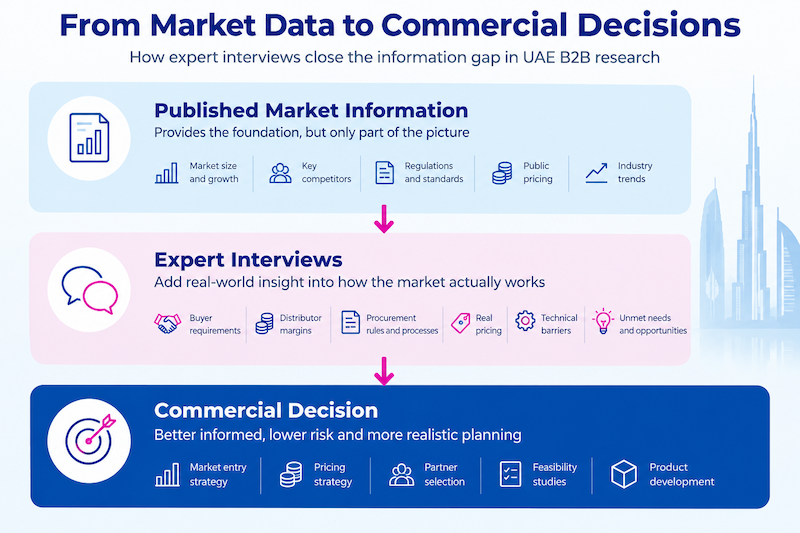
Expert interviews UAE
A company entering through distributors may use interviews to understand margin structure, market coverage, competing principals and the commercial support expected from a new supplier.
A B2B service provider may use interviews to learn who controls the budget, what current suppliers do well, where service gaps exist and which factors actually influence supplier selection.
For competitor intelligence, expert interviews can also add context to a wider Competitor Analysis UAE assignment. In each case, the interview is not the end product. The purpose is to reduce uncertainty around a business decision.
Case Study: Steel Tanks Manufacturing — Validating the Market Before Investment
A European manufacturer of industrial steel tanks was considering whether to establish production in the Gulf. Before committing to a plant, the company needed to validate whether the demand, buyer structure and commercial assumptions behind the investment were realistic.
Expert interviews formed an important part of the research. We spoke with:
- buyers across oil & gas, chemicals and agriculture;
- distributors and wholesalers active in the steel-tank market;
- industry specialists with direct knowledge of regional demand;
- relevant market and regulatory stakeholders.
The interviews helped us understand not only where demand existed, but which segments were growing, how buyers selected suppliers, what distributors expected and where the client’s initial assumptions needed to be adjusted.
These findings were combined with desk research, competitor benchmarking and a full feasibility assessment. The final output was an 85-page feasibility study and a staged market-entry roadmap comparing the commercial and operating case for local manufacturing.
Read the full steel tanks manufacturing case study →
When Expert Interviews Are Not the Right Method
Expert interviews provide depth, not statistical representation.
If the question is how many consumers prefer one product concept over another, a survey is more appropriate.
If reliable factual information already exists in public sources, additional interviews may not add much value.
If the objective is to understand the experience of a large customer base, customer research may be the better starting point.
Good research design does not use expert interviews simply because they are available. It uses them when the decision depends on knowledge that the selected respondents are uniquely positioned to provide.
Timing and Cost
A focused expert interview project may take around two to four weeks, depending on respondent seniority, recruitment difficulty, sector complexity and geography.
The interview itself is usually not the main constraint. Specialist recruitment, scheduling and respondent qualification can take longer than expected, particularly in narrow industries. Cost also varies considerably.
A discussion with an accessible B2B buyer is very different from recruiting a senior technical specialist or a decision-maker from a highly concentrated industry.
Pricing may therefore depend on:
- respondent seniority;
- industry specialisation;
- recruitment difficulty;
- number of interviews;
- interview length;
- geography;
- respondent incentives where applicable;
- screening requirements;
- analysis and reporting requirements.
For most consulting assignments, we scope expert interviews as part of the overall research programme rather than treating them simply as a price-per-interview recruitment service.
What Clients Actually Need From the Output
Management usually does not need dozens of pages of interview transcripts. It needs to know what changed because of the interviews.
Which assumptions were confirmed? Which were challenged? Where did respondents disagree? Which findings are strong enough to influence the strategy? What still needs to be tested? This is where interpretation matters.
At Accurate Middle East, our role is not simply to report what respondents said. It is to connect those conversations to the wider market evidence and the decision the client needs to make.
Discuss an Expert Interview Project in the UAE
If your decision depends on information that cannot be answered reliably through desk research alone, we can help identify the right respondent profiles, recruit relevant experts and design the interviews around the commercial questions you need to resolve.
Talk to our 24/7 AI assistant on WhatsApp and receive a tailored proposal within 24–48 hours. You can also email us at team@meaccurate.com or call us in the UAE on +971 50 559 5603.
Frequently Asked Questions
Expert interviews are used when a company needs information that is not available reliably from public sources. In the UAE, this may include distributor margins, procurement requirements, actual pricing practices, technical specifications, supplier-selection criteria, competitor strengths, channel structure or barriers to market entry. They are particularly useful for feasibility studies, B2B market research, competitor analysis and market-entry projects where management needs to validate assumptions before making an investment or commercial decision.
Expert recruitment normally begins with a precise screening profile. Depending on the assignment, respondents may be checked for current role, company type, sector experience, purchasing responsibility, geography, technical knowledge and direct involvement in the issue being researched. Experts can be sourced through professional outreach, business networks, specialist recruiters and research partners. Accurate Middle East qualifies respondents before fieldwork so that the interview is conducted with someone who can genuinely answer the research questions.
As a working reference, a specialist expert interview in the UAE may typically be budgeted at around AED 1,500–3,500 per interview, depending on respondent seniority, specialisation and recruitment difficulty. This should not be confused with the total cost of an expert-research project. Research design, screening, interview-guide development, analysis, reporting and project management may be priced separately or included within a broader market-research or feasibility-study scope. VAT is additional where applicable.
A focused UAE expert-interview assignment can often be completed in approximately 2–4 weeks. The main variable is usually recruitment rather than the interview itself. Senior executives, highly technical specialists or respondents in narrow industries can take longer to identify and schedule. Projects involving several stakeholder groups may also require more time because findings need to be compared across different perspectives.
Expert interviews explain the market; B2B customer interviews explain the buyer. An expert interview may investigate market structure, distribution, competition, regulation or commercial norms. A B2B customer interview is more likely to explore purchasing criteria, supplier selection, pain points, switching behaviour and unmet needs. In some projects the same respondent can provide both perspectives, but the interview guide and research objective are different.
Expert interviews should not be used alone to calculate a precise market size. They are more valuable for validating the assumptions behind demand estimates. For example, interviews can help confirm which customer segments are genuinely buying, whether published growth is visible in the market, how often products are purchased, which applications are growing and whether distributors consider demand strong enough to support a new entrant.
These findings can then be combined with desk research, company data and other primary research to build a more defensible market estimate.


