
Last Updated: 22 November 2026
Demand forecasting helps companies estimate how demand may change before they commit to production, inventory, staffing, expansion or investment decisions. According to the UAE Ministry of Economy, ongoing economic diversification continues to reshape demand patterns across key industries. Without accurate demand forecasting, companies risk overproduction, stock imbalances, and missed revenue opportunities.
In the UAE, forecasts often need to account for seasonality, pricing, competitor activity, tourism, regulatory changes and differences between customer segments. Accurate Middle East combines internal business data, market research and external market indicators to build practical demand scenarios rather than relying on historical sales alone.
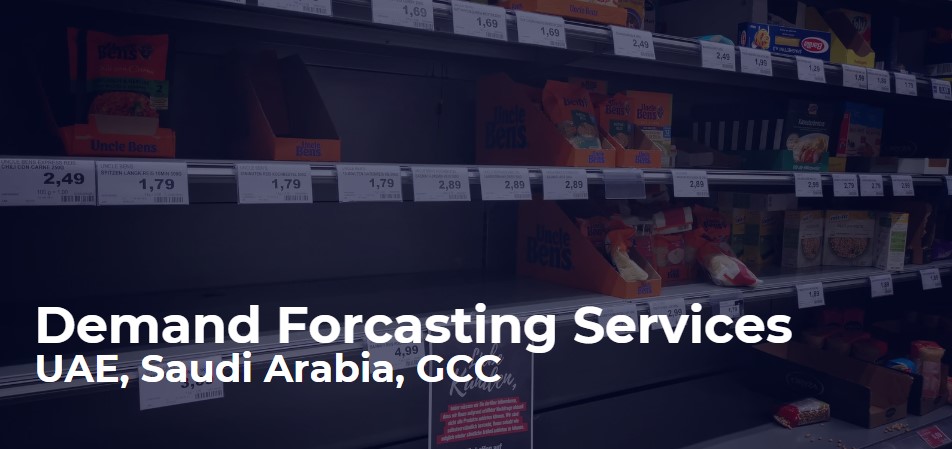
A forecast is useful only when the assumptions behind it are clear, realistic and regularly tested against the market.
When Do Companies Need Demand Forecasting in the UAE?
Companies usually need demand forecasting when a decision depends on future sales, volumes or customer demand rather than only on the current market size. The most common situations include:
The most common situations include:
Entering a new market
Before launching in the UAE, companies need to understand whether real demand exists, how large the opportunity is, and which customer segments are most relevant. Without this, market entry decisions are often based on assumptions rather than data.
Launching a new product or concept
New product success in the UAE depends heavily on positioning, pricing, and timing. Demand forecasting helps estimate expected sales volumes, identify early adopters, and align marketing and distribution strategies.
Scaling production or expanding operations
As businesses grow, forecasting becomes critical for aligning production capacity, staffing, and supply chain planning with realistic demand scenarios.
Planning inventory and supply chain operations
In sectors such as retail and FMCG, inaccurate forecasts lead to overstocking or stockouts – both of which directly impact margins and customer satisfaction.
How Demand Forecasting Works in Practice
A useful forecast normally combines several types of evidence. Historical sales can show patterns, but they are rarely enough on their own, particularly in a market affected by new entrants, pricing changes, seasonality or shifts in customer demand.

Demand Forecasting UAE
Market and demand baseline assessment
Estimating total market size, segment demand, and consumption patterns across relevant customer groups
Historical data analysis (where available)
Reviewing internal sales data, seasonality trends, and past performance to identify demand patterns
External market inputs
Incorporating pricing benchmarks, competitor activity, economic indicators, and regulatory factors that influence demand
Scenario-based forecasting
Building multiple demand scenarios (conservative, realistic, and high-growth) to reflect market uncertainty
Seasonality and behavioral adjustments
Accounting for UAE-specific demand fluctuations, including Ramadan, tourism cycles, and summer seasonality
Validation through qualitative insights
Supporting data with primary research – expert interviews, customer research, or market testing where required.
This combined methodology allows businesses to move beyond static projections and develop realistic, decision-ready demand forecasts aligned with the UAE market environment.
Demand Forecasting and Market Intelligence
Demand forecasting and market intelligence are closely related, but they answer different questions.
Demand forecasting estimates how demand may develop in the future.
Market intelligence tracks the external signals that may change that forecast, such as competitor activity, pricing, new supply, market transactions, regulatory changes and other selected indicators.
For ongoing planning, the two can work together. A forecasting model establishes the expected demand scenarios, while recurring Market Intelligence Services help management see whether the assumptions behind those scenarios are still holding.
Where frequent updates are required, selected indicators can also be brought into a Market Intelligence Dashboard.
Who Uses Demand Forecasting?
Retail and FMCG companies use forecasting to plan inventory, promotions and distribution.
Manufacturers use it to align production capacity and procurement with expected demand.
Healthcare providers use forecasting to plan service capacity, supplies and expansion.
Logistics and supply-chain operators use it to anticipate volumes, capacity requirements and route demand.
Investors and new-market entrants use demand forecasts to test the commercial assumptions behind expansion or investment decisions.
Case Study: Demand Forecasting for an FMCG Product Launch in the UAE
A food and beverage company approached us before launching a new product with unconventional packaging. Initial assumptions about demand were unclear.

Our analysis combined consumer research, competitor benchmarking, price intelligence and seasonal demand modelling.
The work helped the client identify the strongest demand scenarios, refine the product positioning and build a more realistic launch and distribution plan around expected seasonal demand.
Where Demand Forecasting Fails in the UAE
Forecasts usually become unreliable when the model is treated as more important than the assumptions behind it. In the UAE, four problems appear frequently:
Over-reliance on historical data
Past performance does not reliably predict future demand in the UAE, where market conditions shift quickly due to new entrants, pricing changes, and external demand drivers such as tourism and economic cycles
Ignoring seasonality and local demand patterns
Demand is heavily influenced by periods such as Ramadan, Eid, and the summer season. Forecasts that do not reflect these cycles often lead to inaccurate planning and inventory imbalances
Misreading expat vs. local demand dynamics
The UAE is not a uniform market. Purchasing behavior varies significantly between expatriate and local populations, requiring segmentation rather than a single demand assumption
Failure to adjust for regulatory and market changes
Updates in VAT, import regulations, or sustainability policies can quickly impact demand levels, making static forecasting models insufficient
In practice, accurate demand forecasting in the UAE requires combining data analysis with local market insight and continuous validation, rather than relying on a single model or historical dataset.
Cost of Demand Forecasting Services in the UAE
The cost of demand forecasting services in the UAE depends on several factors, including the complexity of the market, availability of data, number of products, and forecasting horizon. Unlike standardized services, demand forecasting requires a tailored analytical approach, combining quantitative models with market intelligence.
Demand forecasting projects in the UAE typically start from around AED 25,000 for a focused single-product forecast and can exceed AED 65,000 for multi-product, multi-segment or scenario-based models. Ongoing forecasting and dashboard programmes are priced separately based on scope, data sources and update frequency.
Typical pricing ranges in the UAE are as follows:
| Project Scope | Typical Deliverables | Estimated Cost (AED) |
|---|---|---|
| Fundamental Forecast (1 product, 1 market) | Baseline demand estimation, high-level assumptions, short-term forecast | 25,000 – 35,000 |
| Comprehensive Forecast (Multi-product / multi-segment) | Detailed demand modeling, segmentation, scenario analysis, medium- to long-term forecast | 35,000 – 65,000+ |
| Ongoing Forecasting & Dashboards | Continuous monitoring, automated models, interactive dashboards, regular updates | Custom pricing |
Our Demand Forecasting Process
1. Define the decision. Clarify what the forecast needs to support: market entry, production planning, inventory, investment, expansion or another decision.
2. Review available data. Assess historical sales, CRM data, inventory records, market data, pricing, competitor activity and other relevant inputs.
3. Build the demand baseline. Estimate current demand and identify the main factors that influence it.
4. Develop scenarios. Build conservative, realistic and higher-demand scenarios using explicit assumptions.
5. Validate the assumptions. Test the forecast against market evidence, expert input, customer research or primary research where required.
6. Deliver the model and recommendations. Provide the forecast, scenario model and management implications in the format required for decision-making.
7. Update where needed. For ongoing planning, the model can be refreshed as market conditions, pricing, competitor activity or internal performance change.
Discuss a Demand Forecasting Project
If you need to estimate future demand for a product, service, market or expansion decision, contact Accurate Middle East to discuss the available data, forecasting horizon and level of detail required.
WhatsApp: Message us on WhatsApp
UAE: +971 50 559 5603
Email: team@meaccurate.com
You can also request a callback or schedule a consultation. For a detailed research request, complete our project brief form.
Frequently Asked Questions
Demand forecasting is the process of estimating future customer demand using data, market trends, and analytical models. In the UAE, it is particularly important due to seasonality, diverse consumer segments, and fast-changing market conditions, which require businesses to plan accurately to avoid overstocking or missed sales.
No demand forecast can remove uncertainty. Accuracy depends on the quality of the historical data, the stability of the market, the assumptions used and how often those assumptions are reviewed. For this reason, we normally present demand as a range or scenario rather than a single guaranteed number.
Businesses typically use demand forecasting when entering the UAE market, launching a new product, scaling operations, or optimizing inventory and supply chain planning. It is also essential when preparing for seasonal demand shifts such as Ramadan or peak tourism periods.
Demand forecasting is widely used across retail, FMCG, manufacturing, healthcare, construction, and logistics. Any industry that relies on supply planning, inventory management, or market expansion can benefit from accurate demand projections.
The cost of demand forecasting services in the UAE typically ranges from AED 25,000 to AED 65,000+, depending on the scope of the project, number of products, data availability, and complexity of the market. More advanced projects involving multiple scenarios or continuous monitoring may require customized pricing.


