
Last Updated: 12 August 2026
Most people who search for a feasibility study consultant in the UAE aren’t asking whether the idea is good. They already believe it is — that’s why they’re here. What they need is a document that survives contact with a bank credit committee, a board, or their own doubt at 2am before signing a lease. This article is written for exactly that person: an owner, investor, or corporate lead deciding whether to enter or expand in the UAE, who needs a straight answer on what a feasibility study actually contains, what it costs in 2026, and how the process works from brief to final report.
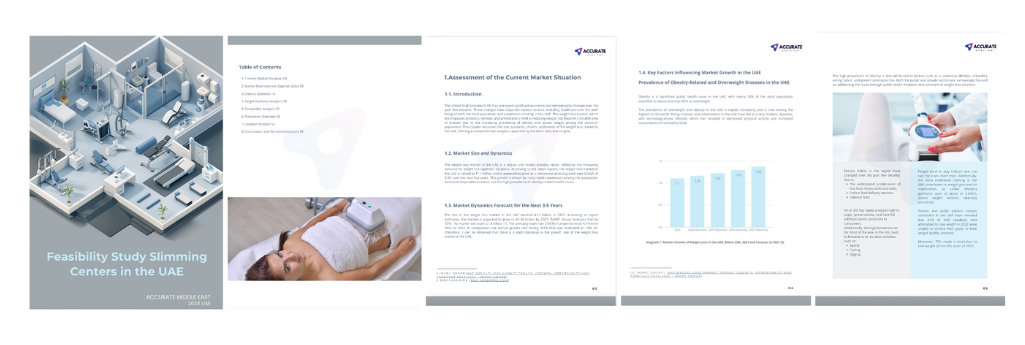
Feasibility Study in UAE
What a Feasibility Study Actually Proves
A feasibility study is not a market overview with a nice cover page. It is a structured test of one specific question: does this business model work, at this scale, at this cost, in this market — and what happens to the numbers if the core assumptions are wrong. Accurate Middle East builds these studies for investors, developers, and companies entering or scaling in the UAE and the wider GCC. Every study combines primary market research, a full financial model, and an operational review into one decision-ready report, built around the specific project rather than adapted from a template.
Engagements are senior-led from the first call to the final presentation. The consultant who scopes your project is the one who builds the model and defends it in front of your investors or your bank. For anyone who has sat through a due diligence meeting where the “expert” on the call can’t answer a follow-up question, this distinction is the entire value of the engagement.
What is a Feasibility Study?
A feasibility study is a structured assessment of whether a proposed investment or business idea is commercially viable. In effect, it combines a market feasibility study, a financial feasibility study, and an operational review — evaluating demand, competition, financial returns, operational requirements and potential risks before significant capital is committed. Its purpose is to help business owners and investors make informed Go/No-Go decisions based on evidence rather than assumptions.
Our 3-Pillar Feasibility Analysis Framework
Every feasibility study we deliver runs on the same underlying feasibility analysis framework UAE investors and lenders recognize, regardless of sector. Rather than producing a single narrative report, we structure the analysis around three pillars that map directly to the questions a bank, board, or investment committee will actually ask: is there a market, do the numbers work, and can the project actually be built and licensed as planned. Each pillar is tested independently, then reconciled — a project that passes on demand but fails on financial sensitivity, or clears the model but stalls on licensing, gets flagged before capital moves, not after.
1. Market Demand & Competitor Validation
This pillar answers whether the opportunity is real before any financial assumptions get built on top of it. Our market demand research Dubai and UAE-wide teams size the addressable market, identify the growth drivers behind it, and profile the target audience by segment and behavior — not just demographic headcount. Competitor benchmarking maps who currently wins the business and why, and pricing models are tested against what the market will actually pay, not what a template suggests it should. The output is a defined gap: the specific, evidenced opening a new entrant can credibly claim.
2. Financial Modeling & Sensitivity Stress-Testing
Demand evidence only has value once it’s translated into numbers that survive scrutiny. Financial modeling UAE engagements from Accurate Middle East build full revenue build-ups tied directly to the validated demand pillar, then map capital allocation across CapEx and OpEx with the same rigor a lender’s own credit team would apply. Every model runs IRR NPV CapEx OpEx analysis across three scenarios — base case, conservative, and optimistic — so a client sees not just the expected outcome, but how the investment behaves if revenue lands lower or costs run higher than planned. A model that only survives under its best-case assumptions isn’t a financial model, it’s a pitch.
3. Legal, Technical & Operational Feasibility
The third pillar tests whether the project can actually be executed as modelled, not just whether it’s profitable on paper. A technical feasibility study Dubai teams commission from us covers location scoring against the specific operational requirements of the business, supply chain and sourcing feasibility, realistic staffing plans, and the licensing pathway — including which government approvals are required and how long each realistically takes. Projects that clear the first two pillars regularly stall here, on a permit timeline or a sourcing constraint nobody priced into the model until it was already too late to adjust cheaply.
The UAE and GCC Market Context
The UAE remains one of the Middle East’s most attractive investment destinations, but also one of its most competitive. A feasibility study in the UAE is about more than estimating market demand. Investors need to evaluate location, competition, customer behaviour, licensing requirements, operating costs and the choice between mainland and free zone structures. These factors vary significantly across Dubai, Abu Dhabi and the other emirates, meaning commercial success often depends as much on local execution as on the business idea itself. Businesses considering a UAE investment should also review the official licensing guidance published by the Dubai Department of Economy and Tourism (DET), particularly when comparing mainland and free zone business structures.
A feasibility study Dubai-based investors commission looks different from one built for Abu Dhabi or Sharjah — free zone eligibility, rental benchmarks, and footfall patterns shift block by block, which is why location-level assumptions matter as much as market-level ones.
When Do You Need a Business Feasibility in the UAE?
A feasibility study earns its cost when a decision involves real capital, a commitment that’s hard to reverse, or an assumption nobody has actually tested in this market. In the UAE, that describes most serious investment decisions, not a narrow subset of them.
Before capital moves, not after. Consumer behaviour, pricing tolerance, and competitive response differ sharply by emirate, channel, and customer segment. Testing demand before the lease is signed is the difference between a confident launch and a costly correction six months in — and correcting a launch always costs more than testing the assumption did.
Before a bank or investor asks for one anyway. Banks, institutional investors, and development finance institutions operating in the UAE expect a structured feasibility document as a condition of funding, not a courtesy. A study with a defensible market size, a financial model that holds up under sensitivity testing, and an honest risk register shortens due diligence and removes the most common reason capital gets delayed.
Before the risks that aren’t visible from outside show up. Licensing timelines, local partner requirements, real estate costs that swing by micro-location, and how established competitors actually respond to a new entrant — these rarely show up in a generic market report, and they’re exactly what determines whether a UAE launch goes to plan.
Before you allocate budget across locations or product lines. The financial model and operational plan built during a feasibility study become the foundation for phasing decisions afterward — which location opens first, which product line gets funded first, and at what level of investment each one deserves.
Do You Actually Need a Feasibility Study?
Not every business decision requires a full feasibility study. The need depends on the level of investment,
the complexity of the market, and how difficult the decision would be to reverse.
| Situation | Recommendation | Why |
|---|---|---|
| Opening your first restaurant in the UAE | Yes | Location, pricing, footfall, competition, operating costs, and customer demand should be tested before signing a lease or committing capital. |
| Expanding an existing business into UAE | Yes | The regulatory environment, customer behaviour, cost structure, and route to market differ significantly from the UAE. |
| Opening a second branch in the same emirate | Usually yes | A lighter feasibility assessment may be sufficient, but the new catchment area, expected sales, rent, and cannibalisation of the existing branch should still be reviewed. |
| Launching a small online business with limited initial investment | Usually no | A focused market validation exercise or competitor and pricing analysis may be more appropriate than a full feasibility study. |
| Investing in a manufacturing facility | Definitely yes | Industrial projects require detailed analysis of land, utilities, raw materials, production costs, logistics, licensing, capacity utilisation, and long-term financial returns. |
What’s Included — A Sample of What You Receive
A complete feasibility study from Accurate Middle East is built around five core deliverables. Every report is prepared for real commercial decision-making and can be presented to investors, banks or licensing authorities.
-
- Market Analysis – Market size, demand assessment, competitor benchmarking, pricing analysis, customer insights and primary research where required.
- Financial Model – Revenue projections, CapEx and OpEx estimates, cash flow forecasts, NPV, IRR, break-even analysis and sensitivity scenarios.
- Operational Assessment – Location analysis, staffing requirements, supplier evaluation, implementation roadmap and operational risks.
- Legal & Regulatory Review – Licensing requirements, mainland vs. free zone assessment, approvals, permits and regulatory considerations.
- Investment Recommendation – Executive summary with a clear Go / No-Go recommendation, key risks, mitigation measures and recommended next steps.
Cost of Feasibility Study in UAE in 2026
The cost of a feasibility study conducted by consultants in Dubai, UAE varies depending on the project’s complexity, data requirements, and business sector. On average, small-scale commercial or retail projects start from AED 40,000 to AED 90,000, while large industrial or multi-location investments may range between AED 100,000 and AED 250,000.
| Package | Use case | Indicative cost | Timeline |
|---|---|---|---|
| Core | Desk research + high-level fin model | AED 30k–40k | 4–5 weeks |
| Plus | + Expert interview / supplier quotes | AED 50k–60k | 5–6 weeks |
| Premium | + Fieldwork (surveys/focus groups) | AED 60k–90k+ | 6–8 weeks |
These figures are indicative. Final pricing depends on the number of markets, locations and product categories covered, the availability of reliable data, and whether the study requires interviews, surveys, supplier quotations or other primary field research.
Our Feasibility Study Methodology
Every feasibility study follows the same evidence-based methodology, adapted to the client’s industry and investment objectives. We begin by defining the commercial questions that need to be answered, then validate market demand through desk research and, where required, interviews with customers, suppliers and industry experts. This is followed by competitor benchmarking, financial modelling, operational and regulatory assessment, and sensitivity testing to evaluate different commercial scenarios. Rather than relying on generic industry reports or standard templates, every recommendation is supported by market evidence and tested against realistic assumptions before we issue a final investment recommendation.
What Makes a Feasibility Study ‘Bankable’ in the UAE?
Not every feasibility study clears a credit committee, and the difference rarely comes down to formatting. A bankable feasibility study UAE lenders will actually act on rests on three things: assumptions derived from real market fieldwork rather than generic industry averages, a dynamic financial model built across a genuine 3–5 year horizon that lets a credit team stress-test CAPEX, OPEX, IRR, NPV, and ROI under different scenarios rather than a single fixed forecast, and a tax and structuring position that reflects current regulation — specifically, UAE Corporate Tax at 9% on taxable income above AED 375,000, and whether the entity qualifies for the reduced or 0% Free Zone rate on qualifying income.
A financial feasibility study Dubai banks are willing to lend against treats these three elements as inputs to the model itself, not footnotes added after the numbers are already finalized.
How to Order a Feasibility Study — Our Process
Every project is different, but our delivery process follows a structured framework designed to minimise risk and ensure that every recommendation is supported by evidence rather than assumptions.
Step 1. Project Scoping (1–3 Business Days)
-
-
- Initial consultation to understand your investment objectives.
- Review of the business concept, target market and geographic scope.
- Definition of project assumptions, deliverables and timeline.
- Agreement on the research methodology and proposal.
-
Step 2. Market Research & Commercial Validation (Weeks 1–3)
-
-
- Market sizing and demand assessment.
- Competitor benchmarking and pricing analysis.
- Customer, supplier and industry expert interviews (where applicable).
- Market opportunities, risks and commercial viability assessment.
-
Step 3. Financial Modelling (Weeks 2–5)
-
-
- Revenue and sales forecasting.
- Capital expenditure (CapEx) and operating expenditure (OpEx) modelling.
- Cash flow projections, profitability, break-even analysis, NPV and IRR.
- Sensitivity analysis under different commercial scenarios.
-
Step 4. Operational & Regulatory Assessment
-
-
- Review of licensing and regulatory requirements.
- Location, staffing and operational planning.
- Supply chain and procurement considerations.
- Key implementation risks and mitigation measures.
-
Step 5. Final Report & Investment Recommendation
-
-
- Comprehensive feasibility study report.
- Executive summary for investors or management.
- Clear Go / No-Go recommendation.
- Presentation of findings and discussion of next steps.
-
Industries We Cover
Every industry requires a different analytical framework. We tailor each feasibility study to the commercial realities of the sector rather than applying a generic template.
Our experience includes:
-
-
- Manufacturing & Industrial – Utilities, production costs, logistics, supplier networks and permitting.
- Healthcare – Demand forecasting, patient volumes, payer mix, licensing and operational capacity.
- Hospitality & F&B – Footfall analysis, catchment areas, pricing strategy, occupancy and delivery mix.
- Real Estate – Market demand, absorption rates, pricing scenarios, development costs and investment returns.
- Retail & Consumer Services – Customer demand, competitive positioning, location assessment and pricing.
- Professional Services, Technology – Market potential, commercial viability, customer acquisition and expansion strategy.
- Automotive – Launch of new cars & models, new business models, market validation, feasibility of new ventures.
-
Case Studies in the UAE market
Case Example: Boutique Pilates Studio, Feasibility Study Dubai
A client planned to open a premium Pilates studio in Dubai and had already shortlisted several locations. Our feasibility study combined competitor benchmarking, customer research, pricing analysis and financial modelling. While demand for boutique fitness was strong, the preferred location was unlikely to achieve the required occupancy to reach the client’s target return. After comparing alternative locations and refining the pricing strategy, the client proceeded with a revised concept supported by stronger financial projections.
Read the full case study →
Case Example: Medical Centre Feasibility Study
Before investing in a specialised healthcare facility in Dubai, the client wanted to validate market demand, licensing requirements and long-term financial viability. Our study assessed patient demand, competitor positioning, pricing, staffing requirements and regulatory considerations. The final recommendation helped the investor refine the service offering before committing to the project.
Read the full case study →
Case Example: Manufacturing Investment
A manufacturing client evaluating a new production facility required a detailed assessment of market demand, production costs, supply chain risks and expected returns. Our feasibility study combined market analysis with a detailed financial model and operational assessment, providing management with the evidence required to make an informed investment decision.
Read the full case study →
What Makes Our Feasibility Studies Different?
Many feasibility studies look impressive on paper but rely almost entirely on published market reports and standard financial templates. Our approach is different. As business feasibility consultants Dubai-based investors return to for repeat engagements, every engagement is built around the client’s specific investment decision and combines independent market validation with commercial, financial and operational analysis.
Our feasibility studies typically include:
-
-
- Primary market research where it matters – Customer, supplier, distributor and industry expert interviews to validate assumptions instead of relying solely on third-party databases.
- 100+ completed feasibility studies across the GCC – Experience covering manufacturing, healthcare, construction, real estate, hospitality, retail, professional services and other sectors.
- Specialist knowledge of both the UAE and Saudi Arabia – We understand that licensing, regulations, customer behaviour and commercial models differ significantly between GCC markets.
- Bank-ready financial modelling – Financial models prepared by ACCA-qualified consultants with experience supporting investment decisions, financing discussions and board presentations.
- Senior consultants throughout the engagement – The consultant who scopes your project remains involved until the final presentation. There is no handover to a junior delivery team.
- Evidence-based recommendations – Every conclusion is supported by market research, financial analysis and operational assessment rather than assumptions or generic templates.
- Independent commercial advice – If the analysis shows that a project should be postponed, redesigned or not proceed, we say so. The purpose of a feasibility study is to reduce investment risk—not simply to justify an investment that has already been made.
- Proprietary research capability – Access to our GCC network of professionals, industry experts and decision-makers enables us to recruit interview participants faster and validate commercial assumptions using local market evidence rather than secondary sources.
-
Start With a Conversation
Feasibility study engagements begin with a short intake call — 30 to 45 minutes — to understand your project, timeline, and what the study needs to answer. A scoped proposal with methodology, deliverables, and investment follows within 24-48 hours.
To get started, email us with your task description at team@meaccurate.com, fill in the brief or contact us via WhatsApp and describe your task in a real time.
 | |
Author: | |
| Dr. Elena Zhukovskaya Senior Consultant, Partner | |
| 20+ years of experience in market research, business management, investor relations, and brand communications across the UAE, KSA, and GCC. Author of 50+ publications and a regular speaker at leading business events in the region. Linkedin profile |

Frequently Asked Questions
A complete feasibility study UAE and Saudi Arabia covers five pillars: (1) market research with a defendable market size estimate and competitor map; (2) a decision-ready market report summarizing demand drivers, pricing, and positioning; (3) a bank/investor-ready financial model (revenue build-up, CapEx/OpEx, cash flow, NPV/IRR, sensitivity); (4) operational and technical feasibility (location, staffing, suppliers, implementation plan); and (5) legal & regulatory notes (licensing pathway, timelines). The output is an investor-ready report with a clear go/No-go, risks, and next steps.
Typical engagements range from AED 60,000–80,000 depending on scope, sector, and whether primary fieldwork is required. Timelines run 4–8 weeks: week 1–2 research and data validation, week 3-5 modeling and scenarios, week 6–8 final report and stakeholder review. Costs rise with deeper market research, more interviews, multiple locations, or extra scenarios. We agree milestones up front and share a mid-project preview so you can steer assumptions early.
A feasibility study answers “Should we do this?” by proving market size, pricing power, costs, and expected returns; it ends with go/No-go and risk mitigations. A business plan answers “How will we execute?” with branding, org chart, marketing calendar, and operational SOPs. In the UAE, lenders and investors often ask for a feasibility report (with a model) first; once the project is viable, the business plan translates it into day-to-day execution.
We combine top-down sources (official statistics, trade and property registries) with bottom-up evidence (price checks, channel interviews, demand proxies). The model triangulates population/footfall, spend per user, penetration, and capacity constraints to produce a realistic market size and ramp-up curve. Findings are written into a concise market report: demand forecast, competitor positioning, price ladders, and “what it means” for your concept—so investors can see both the numbers and the story behind them.
A real estate feasibility study in Saudi Arabia or the UAE focuses on absorption and pricing by micro-location, off-plan vs ready dynamics, yields, and service-charge impact, handover timing, and buyer/tenant profiles. We stress-test scenarios against mortgage rates, construction costs, and delivery schedules, then translate results into sales pace, cash flow, and ROI. The deliverable is an investor-ready report and model that shows whether the scheme should proceed, at what unit mix/price, and with which phasing to reduce risk.


