
Last Updated: 26 October 2026
A wellness concept can look excellent on paper and still fail because it opened three kilometres in the wrong direction. We see this often when investors assess gyms, Pilates studios, spas, slimming concepts and other wellness businesses in the UAE. The first conversation tends to be about the idea: the interior, equipment, classes, treatments, brand and price point. The harder questions come later. Who will actually use it? How often? What are they already paying? How far will they travel? Is the catchment large enough? And how many similar concepts are already competing for the same customer?

Wellness Market Research UAE
Those questions are why wellness market research in the UAE needs to go much further than a general industry report.
Accurate Middle East works with investors and operators evaluating wellness, fitness and lifestyle concepts across Dubai, Abu Dhabi, Sharjah and the wider UAE. Our work can combine market research, customer research, competitor benchmarking, pricing, mystery shopping, location analysis and financial feasibility.
Sometimes the research confirms the original idea. Sometimes it changes it quite significantly before a lease is signed. That is usually cheaper than discovering the problem after opening.
The UAE Wellness Market in 2026: Strong Growth, but Not One Single Market
The latest comprehensive country-level data from the Global Wellness Institute values the UAE wellness economy at approximately USD 40.8 billion, based on 2024 activity and published in late 2025. Between 2019 and 2024, the sector recorded average annual growth of around 14.3%, making the UAE one of the fastest-growing wellness economies in the Middle East and North Africa over that period.
By 2026, that growth story matters less as a headline and more as a signal of how broad the market has become. Wellness in the UAE now spans fitness, pilates and boutique studios, spas, preventive health, recovery concepts, personal care, wellness tourism, nutrition, slimming, medical wellness and increasingly specialised services aimed at specific customer groups.
The size of the underlying segments also shows how diverse the market is. Personal care and beauty accounted for approximately USD 14.8 billion in 2024, while wellness tourism represented around USD 11.3 billion. Wellness real estate reached approximately USD 1.4 billion, reflecting the growing role of wellness in residential, hospitality and lifestyle developments.
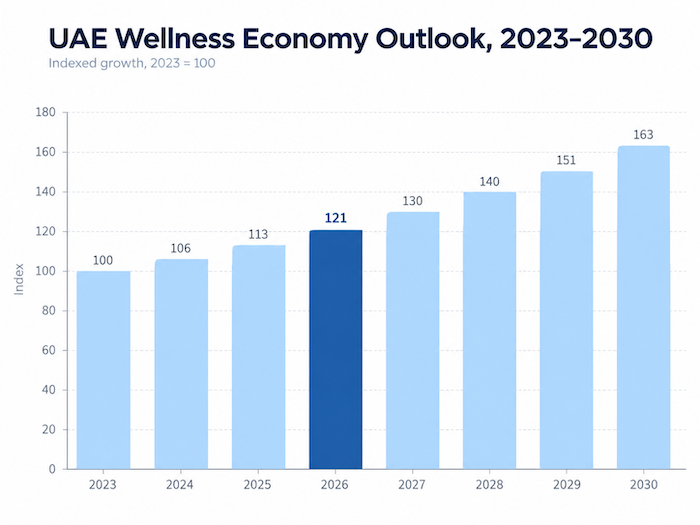
UAE Wellness Economy Growth Outlook and Forecast 2026-2030
Current market activity suggests that this expansion is continuing into 2026. Consumers are moving beyond conventional gym memberships towards boutique fitness, reformer Pilates, recovery and mobility services, personalised wellness, preventive health and concepts that combine physical and mental wellbeing. At the same time, operators are becoming more specialised, which increases competition within individual niches even when the overall market is still growing.
For the latest country-level wellness economy data, see the Global Wellness Institute UAE report.
But a USD 40.8 billion wellness economy does not mean that every new studio, spa or wellness concept has a viable market. An investor planning a 250-square-metre Pilates studio in a residential Dubai community is not competing across a USD 40 billion national industry. The commercially relevant market may be a relatively small catchment of residents who live or work within a practical travel radius, can afford the proposed price, prefer that format and are not already satisfied with an existing provider.
That is why wellness market research in the UAE has to move quickly from national statistics to the actual commercial question: how much demand exists for this specific concept, in this location, at this price, against the competitors already serving the same customer?
Why “Wellness” Is Not One Market
The word wellness is convenient, but commercially it can be misleading.
A Pilates studio, a large fitness club, a day spa and a medically supervised slimming centre may all appear in the same wellness discussion. Their economics are completely different.
| Concept | What Usually Drives Demand | Location Sensitivity | Typical Research Priority |
|---|---|---|---|
| Pilates / Boutique Fitness | Convenience, instructor quality, class schedule, community, concept and price | Very high | Catchment, competitors, customer profile, class mix, pricing and retention |
| Gym / Fitness Club | Equipment, location, opening hours, membership value, facilities and accessibility | High | Membership demand, competitor capacity, pricing, demographics and utilisation |
| Spa | Experience, treatment quality, positioning, location, reputation and tourism/resident mix | High but concept-dependent | Treatment mix, pricing, competitor experience, customer segments and footfall sources |
| Wellness / Recovery Concept | Perceived benefit, trust, novelty, repeat usage and complementary services | Medium to high | Concept validation, willingness to pay, education required and repeat-use potential |
| Slimming / Medical Wellness | Results, medical credibility, trust, treatment packages and customer acquisition | Medium to high | Demand, pricing, regulation, patient profile, competing clinics and treatment economics |
This is why we would not recommend beginning a wellness feasibility study with a generic statement such as “the UAE wellness market is growing.” It is true. It is also not enough to make an investment decision.
What Investors Usually Get Wrong
One recurring mistake is starting with the property. An investor sees a vacant unit, likes the neighbourhood and begins negotiating the lease. Only afterwards does someone check whether the proposed customer base is large enough or whether five similar studios already operate within ten minutes. Ideally, the sequence should be reversed.
First define the concept and likely customer. Then assess demand. Map the competitive environment. Understand price points and customer behaviour. Shortlist suitable areas. Only after that should individual properties become the focus.
Another common mistake is copying successful competitors too literally. If three premium Pilates studios charge a particular price, this does not automatically mean a fourth studio can charge the same amount. The competitors may have stronger instructors, an established community, a better building, easier parking or years of customer reviews behind them.
And there is a third issue: investors often confuse stated interest with demand. People frequently say they would like to exercise more, receive massages more often or try a new wellness service. What matters commercially is whether they will pay the proposed price, at the proposed frequency, in the proposed location.
How We Test Whether a Wellness Concept Can Actually Work
The research normally moves between three levels: the market, the customer and the location.
Market and Competitor Evidence
We first define the real competitive set. This is rarely every gym or studio in the emirate.
For a boutique concept, the relevant competitors may be businesses serving a similar customer within a practical travel radius. We look at their service mix, prices, memberships, schedules, customer reviews, visible capacity, positioning, promotions and location characteristics.
Mystery shopping can be particularly useful here. A website shows what the operator wants to communicate. A call, visit or booking journey shows what a customer actually experiences.
Customer Research
Customer research is where many wellness concepts either become more convincing or start to change.
Depending on the decision, we may test preferred formats, current spending, class frequency, willingness to travel, membership preferences, time slots, barriers, reasons for changing providers and willingness to pay. For a Pilates concept, for example, knowing that respondents “like Pilates” has limited value. We need to know whether they already attend, where they attend, what they pay, how often they go, what prevents them from attending more often and what would make them switch.
This type of direct work connects with our broader Customer Research UAE capability.
Location Analysis
Location analysis deserves much more attention than it normally receives in a standard feasibility study. For a neighbourhood-led wellness concept, a good location is not simply a busy location. A location can have high traffic and still be wrong for the target customer. Another site may look quieter but sit inside a dense residential catchment with the right household profile and very little direct competition.
Our location work can combine field checks with map-based analysis. Depending on the project, we can review:
- competitor density and distance;
- residential and commercial catchments;
- travel times;
- road access;
- parking;
- nearby schools, offices, retail and community facilities;
- visibility and access constraints;
- surrounding customer generators;
- rental cost relative to expected revenue potential.
For larger screening exercises, parts of this process can also be automated using mapping data and APIs. Rather than manually checking dozens of areas one by one, geographic data can be used to screen locations against agreed criteria, identify clusters and narrow the field before physical site assessment begins. This does not replace a site visit, but it makes the site visit more intelligent.
Dubai, Abu Dhabi and Sharjah Are Different Wellness Markets
It is tempting to treat the UAE as one affluent, urban wellness market. In practice, the commercial conditions can change materially between emirates and even between neighbourhoods in the same city.
Dubai
Dubai offers scale, international consumers, premium residential catchments, tourism and a large number of established fitness and wellness concepts. It also brings high rents and intense competition.
For many boutique concepts, the question in Dubai is not whether customers exist. It is whether enough of the right customers exist within a practical catchment and whether the concept is sufficiently differentiated to win their attention repeatedly.
Abu Dhabi
Abu Dhabi can support premium wellness concepts, but customer geography, community patterns and competitive density differ from Dubai. A concept that works well in Jumeirah or Dubai Marina cannot simply be transplanted into Abu Dhabi with the same assumptions. The local catchment and service mix need to be tested independently.
Sharjah
Sharjah is particularly interesting for concepts that rely on residents and repeat use rather than tourism. Pricing, parking, residential density and convenience can become more important than prestige. That changes both the concept and the financial model.
For a studio relying on customers attending two or three times per week, ten minutes of additional travel or difficult parking can matter more than an expensive fit-out.
A Pilates Feasibility Project: Starting With Demand, Not the Lease
In a recent UAE assignment, Accurate Middle East was asked to assess the feasibility of a new Pilates studio. The project did not begin with a predetermined location.
We first looked at the market: existing studios, pricing, class formats, service mix and the way competing businesses positioned themselves. Customer research was then used to understand what potential users actually wanted, including preferred formats, pricing expectations, frequency and the practical factors that influence studio choice. The location question came after that.

How to start a wellness or pilates business in the UAE
Potential areas were assessed against the emerging customer profile and business model. Competitor presence, accessibility, parking, surrounding residential demand and local market characteristics were considered alongside property economics.
The work also included mystery shopping and site checks because some information cannot be understood reliably from Google Maps or a competitor website alone.
Finally, the research fed into the financial model: expected memberships and class demand, pricing, operating costs, fit-out assumptions and the revenue level required to make the studio viable. The sequence mattered.
Had location been selected first, the research would have been reduced to an exercise in justifying a decision already made. Instead, the evidence was allowed to influence the concept, location shortlist and financial assumptions.
Read our Pilates Studio Research & Feasibility Study case.
Other Wellness Projects in the UAE
The questions are different for every wellness concept. A studio may depend heavily on neighbourhood catchment and repeat visits; a premium spa may rely on tourism, hotels and discretionary spending; a medical-wellness concept introduces another layer of regulation, clinical credibility and treatment economics.
Luxury Spa and Wellness Centre in Dubai
In another assignment, an international entrepreneur with hospitality experience asked us to assess the feasibility of a premium spa and wellness centre in Dubai. The proposed concept combined rejuvenation, detox and holistic wellness programmes aimed at higher-income residents and visitors.
The work went considerably further than estimating whether Dubai had demand for spa services. We benchmarked more than 20 wellness centres across Dubai and Abu Dhabi, reviewed their treatment and pricing structures, and assessed potential locations using factors such as visitor traffic, tourism activity and proximity to luxury hotels. The analysis then fed into the feasibility study, business plan and five-year financial model, covering investment requirements, operating costs, breakeven and alternative scenarios.
The research identified an opportunity around premium, personalised wellness experiences and helped refine the proposed service mix, positioning and location criteria before investment decisions were made.
For projects requiring market validation together with financial modelling and investment assessment, see our Feasibility Study UAE service.
Slimming and IV Therapy Clinic Concept in Dubai and Abu Dhabi
A different project sat at the intersection of wellness and healthcare. The client was evaluating a chain combining medically supervised slimming services with IV nutrient therapy in Dubai and Abu Dhabi.
Here, conventional wellness benchmarking was not enough. The research covered competing slimming centres and wellness clinics, service and package pricing, customer profiles and spending behaviour, as well as regulatory and licensing considerations associated with medical and aesthetic services. We also assessed demand for slimming and IV-therapy services and translated the findings into the proposed business model and financial assumptions.
One of the questions was whether the same format should simply be repeated in both emirates. The analysis instead supported differentiated concepts: a broader premium flagship format in Dubai and a more focused branch model for Abu Dhabi. This is a useful example of why UAE wellness research should not automatically assume that one concept, price structure or operating model will work identically across locations.
For projects involving regulated clinics, healthcare demand, competitors, patients and market entry, see our Healthcare Market Research UAE page.
Pricing: Competitor Prices Are Only the Starting Point
Wellness pricing is unusually visible. Studios publish class packs. Gyms advertise memberships. Spas promote treatment menus. This can create the impression that price analysis is easy, but it’s not. A useful comparison needs to adjust for what the customer is actually receiving. A Pilates class with four reformers is not directly comparable with a class of twelve. An annual gym membership with pool, sauna and group classes is not comparable with a basic access membership. A massage in a five-star hotel spa exists in a different purchase context from the same treatment in a neighbourhood wellness centre.
We therefore look at price together with format, capacity, duration, location, inclusions, promotions and positioning. Then comes the harder question: what price can the new concept sustain? That may require customer research rather than competitor observation alone.
Customer Behaviour Matters More Than Demographics Alone
Age and income are useful, but they rarely explain enough. For many wellness concepts, behavioural questions are more valuable: Does the customer already pay for this service? How frequently? At what time of day? How far do they currently travel? Do they buy memberships or individual sessions? What makes them stop? What would persuade them to change?
Two women of the same age and income living in the same Dubai neighbourhood can have completely different wellness behaviour. One may attend reformer Pilates three times per week and plan her schedule around it. Another may like the idea of Pilates but have attended twice in the past year. They should not be treated as equal demand.
Location Can Be Modelled Before It Is Visited
We increasingly see location analysis as a data problem first and a property problem second. For concepts with a strong local catchment, geographic analysis can be used to screen areas before the client spends time negotiating individual properties.
Mapping tools and APIs can help bring together competitor locations, travel distances, nearby residential communities, commercial centres, schools, hotels or other relevant demand generators. Locations can then be scored against criteria agreed for the concept.
The analysis can be made more sophisticated when additional data is available. A studio may care about dense premium residential communities. A wellness clinic may place more weight on road access, parking and proximity to complementary healthcare services. A hotel spa operates under a completely different model again. The technology is useful because it allows more locations to be screened consistently.
A map does not tell you that a building entrance is awkward, that parking feels unsafe at night or that the attractive unit is almost invisible from the road. Those details still need field validation.
What to Check Before Signing a Wellness Business Lease
A lease is often the point at which a wellness idea becomes expensive. Before committing, we would want to understand at least four things.
Is There Enough Real Demand?
Not general interest in wellness. Demand for this concept, at this price, in this area.
Can the Business Win Customers From Existing Alternatives?
If competitors already serve the catchment well, the concept needs a reason to exist beyond attractive interiors.
Does the Location Fit Customer Behaviour?
Travel time, parking, opening hours and surrounding uses can affect repeat visitation. This is especially important for businesses that depend on frequent attendance.
Does the Financial Model Survive Realistic Assumptions?
Rent, fit-out and staffing are usually visible. Customer acquisition, ramp-up time, utilisation and retention are easier to underestimate.
A feasibility study should connect these assumptions back to market evidence rather than simply applying an optimistic growth curve. For projects requiring the full commercial and financial assessment, see our Feasibility Study UAE service.
Wellness Market Research for Investors and Operators
The UAE wellness market remains attractive going into 2026. The growth data supports that view, and consumer interest in fitness, preventive health, recovery and wellbeing continues to create room for new concepts, but attractive markets also attract competition.
The more active the sector becomes, the less useful it is to rely on broad market growth as justification for one particular business. A pilates investor needs to understand pilates customers. A spa operator needs treatment economics and customer experience benchmarks. A fitness concept needs membership demand, competitive capacity and retention assumptions. A wellness clinic may need all of that plus regulatory and healthcare considerations.
That is how we approach wellness market research at Accurate Middle East: start with the decision, narrow the market until it reflects the actual business, then connect customer evidence, competitor intelligence and location economics before the investment is made.
Discuss Your Wellness Business in the UAE
If you are considering a Pilates studio, fitness concept, spa, wellness centre or related business in the UAE, we can help assess the market before you commit to the location, fit-out or operating model.
To request a service of market research, you can fill in the brief or talk to our 24/7 AI assistant on WhatsApp and receive a tailored proposal within 24–48 hours. You can also email us at team@meaccurate.com or call us in the UAE on +971 50 559 5603.
 | |
Author: | |
| Dr. Elena Zhukovskaya Senior Consultant, Partner | |
| 20+ years of experience in market research, business management, investor relations, and brand communications across the UAE, KSA, and GCC. Author of 50+ publications and a regular speaker at leading business events in the region. Linkedin profile |

Frequently Asked Questions
The UAE wellness economy is estimated at approximately USD 53 billion in 2026 based on an Accurate Middle East extrapolation of the latest Global Wellness Institute data. GWI valued the market at USD 40.8 billion in 2024 and reported average annual growth of 14.3% between 2019 and 2024. If that growth rate continued, the market would reach approximately USD 46.6 billion in 2025 and USD 53.3 billion in 2026. The 2026 figure is an estimate rather than an officially published market size.
The UAE can offer strong opportunities for wellness businesses, but viability depends heavily on the concept, target customer, price and location. A growing national wellness market does not automatically mean there is sufficient demand for a particular Pilates studio, spa, fitness club or wellness centre. Market validation should therefore assess the local catchment, competitors, customer behaviour and expected financial performance before investment.
Wellness market research in the UAE can include demand assessment, competitor analysis, customer research, pricing, service benchmarking, mystery shopping, location analysis and market-entry assessment. For investment projects, the research can also feed into a feasibility study and financial model covering revenue assumptions, operating costs, investment requirements and breakeven.
Demand should be assessed at the level of the actual customer catchment rather than using UAE-wide market statistics alone. For a pilates or boutique fitness concept, research may examine existing customer behaviour, class frequency, preferred formats, willingness to pay, travel distance, competitor capacity, neighbourhood demographics and barriers to switching from existing providers.
Location is often one of the most important factors affecting the performance of a wellness business, particularly for concepts that depend on frequent repeat visits. Location analysis can assess competitor density, residential and commercial catchments, travel times, parking, accessibility, nearby demand generators and property costs. Mapping tools and APIs can also be used to screen and compare potential locations before detailed site visits.
Focused wellness market research projects in the UAE typically start from around AED 37,000 (approximately USD 10,000). More comprehensive assignments involving customer research, mystery shopping, location analysis and financial modelling cost more, depending on the number of locations, sample size and complexity of the concept.
Opportunities differ significantly by emirate and customer segment. Dubai supports a large and competitive market for boutique fitness, pilates, premium spas, recovery and specialised wellness concepts; Abu Dhabi can support premium and community-focused models; while Sharjah may offer opportunities where convenience, residential catchment, parking and value positioning are especially important. Each opportunity should be tested against local demand and competition rather than treated as a UAE-wide trend.


