
Last Updated:16 July 2026
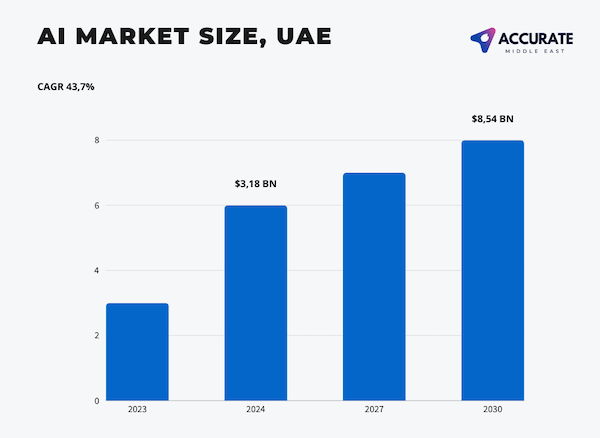
The UAE’s AI market was valued at USD 3.18 billion in 2023 and is forecast to reach USD 8.54 billion by 2030 — a 43.9% CAGR, among the fastest of any market Grand View Research tracks globally. That growth is not organic; it is state-directed. That growth is not organic; it is state-directed.That growth is not organic; it is state-directed. The National AI Strategy 2031 and the Dubai AI Blueprint set specific adoption, investment and talent targets, and public procurement is increasingly structured around them.
For companies entering this market — as a vendor, an investor or an operator — three questions matter more than the headline growth number: which sectors are actually converting AI pilots into paid deployments, what the Dubai AI Blueprint and UAE data localization rules require before you can operate, and where the real competitive gaps sit. This report addresses all three, using primary market data rather than aggregated industry commentary.

UAE Ai market opportunities
Ai Market Size in the UAE: 2023–2030
Two independent forecasts converge on the same direction, even if the absolute figures differ by methodology and scope:
| Source | 2023/2024 Value | 2030 Forecast | CAGR |
|---|---|---|---|
| Grand View Research | USD 3.18B (2023) | USD 8.54B | 43.9% |
| Statista | USD 949.8M (2024) | USD 4.285B | 28.54% |
The gap reflects scope, not disagreement: Grand View Research’s figure captures the broader AI-enabled technology market, while Statista’s is narrower, focused on core AI software and services spend. For market entry planning, the CAGR trend matters more than pinning down a single number — both datasets agree the UAE AI market is compounding at 28–44% annually through 2030, among the fastest growth rates Grand View Research tracks globally.
By technology: Machine learning and computer vision lead current deployment; deep learning holds the largest share of investment due to its use across healthcare imaging, fraud detection and predictive maintenance.
By end-user industry: IT and telecommunications remain the largest adopter segment, followed by healthcare, BFSI (banking, financial services and insurance) and retail — consistent with where we see actual RFP and pilot activity in client engagements.
What is the AI Market and How It Evolves in the UAE
The AI market refers to the development, application, and commercialization of technologies that enable machines to perform tasks that would typically require human intelligence. This includes machine learning, deep learning, natural language processing, computer vision, robotics, and more. In the UAE, AI has become a strategic priority, driven by the government’s vision to position the nation as a global leader in innovation.
Ai UAE Market Size and Growth Forecasts: Opportunities for Business
AI Market Opportunities UAE
● Grand View Research estimates that the UAE AI market size was valued at USD 3.18 billion in 2023 and projects a compound annual growth rate (CAGR) of 43.9% from 2024 to 2030, potentially reaching USD 8.54 billion by 2030.
Grand View Research
● Statista projects the UAE Ai market to reach USD 949.80 million in 2024, with a CAGR of 28.54% from 2024 to 2030, resulting in USD 4.285 billion by 2030.
Statista
Market Segmentation
● By Technology: Machine learning, natural language processing, and computer vision are leading technologies, with deep learning holding the largest market share due to its extensive applications in various industries.
● By End-User Industry: The IT and telecommunications sector is the largest adopter of AI, followed by healthcare, BFSI (banking, financial services, and insurance), and retail.
AI Adoption Trends in the UAE
| Driver | What’s Actually Happening |
|---|---|
| Government mandate | UAE appointed the world’s first Minister of State for AI in 2017; National AI Strategy 2031 sets sector-level adoption targets across healthcare, transport, education and energy |
| Startup investment | AI-focused venture funding is concentrated in fintech, healthcare and logistics, where measurable ROI is easiest to demonstrate to investors |
| Talent pipeline | Dubai AI Campus at DIFC Innovation Hub is training AI leadership cohorts in partnership with Oxford Saïd Business School, Udacity and the Minerva Project — a direct response to the local talent gap |
| Cross-sector deployment | Finance, healthcare, retail and transport show the most active production deployments (not just pilots) — see sector breakdown below |
The Dubai AI Blueprint: What It Means for Market Entrants
The Dubai Universal Blueprint for Artificial Intelligence, launched under Dubai Economic Agenda D33, targets AED 100 billion in annual AI-driven economic contribution and a 50% productivity increase across government and priority sectors. It consolidates previously separate AI initiatives — including the Dubai AI and Web3 Campus — under a single governance structure with four strategic pillars:
- Priority-sector AI deployment — applying AI in the sectors Dubai has designated as strategic;
- A regulatory and governance sandbox — testing environments for AI companies operating ahead of finalized regulation;
- Government-first adoption — including the appointment of Chief AI Officers across government entities;
- A competitive environment for AI companies and talent — licensing, visas and free zone incentives designed to attract AI firms.
For companies selling into government or regulated sectors, this matters commercially, not just politically: procurement increasingly favors vendors who can demonstrate alignment with Blueprint priorities, and the regulatory sandbox is the practical entry point for companies whose AI products don’t yet fit existing licensing categories.
Use Cases and Sector Opportunities in the UAE
Adoption is uneven across sectors — some are running production deployments, others are still at pilot stage. This distinction matters more than headline adoption numbers:
Healthcare: AI-assisted diagnostics and medical imaging are moving from pilot to procurement in both public and private hospital networks, driven by national digital health targets.
Financial services (fintech): Fraud detection and automated credit scoring are the most mature use cases — largely because they sit inside the Central Bank’s existing risk and compliance infrastructure, making them easier to justify to boards than experimental use cases.
Transport and logistics: Dubai’s RTA has already deployed over 40 AI use cases in production, including a 30%-growing Big Data Platform integrating 49 internal systems — one of the clearest examples of “AI as infrastructure” rather than “AI as pilot” anywhere in the region.
Retail and e-commerce: Recommendation engines and demand forecasting are widespread; dynamic pricing adoption is earlier-stage and more contested, particularly in regulated retail categories.
GCC Tech Adoption: How the UAE Compares to Saudi Arabia
The UAE and Saudi Arabia are pursuing AI leadership through different mechanisms. The UAE’s approach is government-infrastructure-led — the Dubai AI Blueprint, Chief AI Officer mandates, and sandbox regulation aim to make Dubai a production environment for AI companies. Saudi Arabia’s approach under Vision 2030 and SDAIA is more capital-led — projecting AI’s economic contribution at over USD 135 billion by 2030, roughly 12–13% of national GDP, backed by giga-project spending and sovereign fund allocation.
| UAE | Saudi Arabia | |
|---|---|---|
| Primary driver | Government infrastructure & regulatory sandbox | Vision 2030 capital deployment |
| Lead sectors | Transport, finance, healthcare | Government/smart cities, energy, giga-projects |
| 2030 economic target | AED 100B annually (Dubai, via Blueprint) | USD 135B (12–13% of GDP) |
For companies weighing which market to enter first, or planning both, our full analysis of Saudi Arabia’s AI market, sectors and entry strategy covers SDAIA’s regulatory structure, giga-project opportunities and procurement dynamics in depth.
Data Localization & Regulatory Compliance for AI in the UAE
The UAE does not yet have a standalone AI law. AI systems are governed through existing frameworks — primarily the Federal Personal Data Protection Law (PDPL), sector-specific regulation, and free zone rules — which means compliance obligations depend heavily on what sector you’re deploying into and which data your system touches.
What applies to every AI deployment:
| Framework | Scope | Key Obligation |
|---|---|---|
| Federal PDPL (Decree-Law No. 45/2021) | All UAE-resident personal data, including data processed by entities outside the UAE | Lawful basis for processing, UAE Data Office oversight |
| DIFC Data Protection Law | Entities licensed in DIFC | GDPR-aligned regime; fines up to USD 100,000 under Schedule 2 |
| ADGM Data Protection Regulations | Entities licensed in ADGM | GDPR-aligned regime; fines up to USD 28 million for serious breaches |
Sector-specific localization rules that directly affect AI architecture:
- Financial services: The Central Bank of the UAE requires customer and payment data to remain in-country; cloud outsourcing arrangements must preserve regulator access. Any AI system processing payment or customer financial data needs UAE-based storage and processing.
- Healthcare: Under Federal Law No. 2 of 2019, electronic health data must be stored in the UAE, with cross-border transfer prohibited except in specifically authorized cases. AI diagnostic or patient-data tools cannot default to offshore infrastructure.
- Government and critical infrastructure: Increasingly moving toward sovereign cloud requirements, reflecting the broader push toward AI-native government services.
What this means in practice: Global AI vendors are already adapting. Microsoft, for example, began offering in-country data processing for Microsoft 365 Copilot in the UAE in early 2026, developed in coordination with the Dubai Electronic Security Center specifically to meet local AI governance requirements. Any company deploying AI into regulated UAE sectors should expect the same question from procurement: where does the data actually sit, and who can access it?
This is not a one-time legal check — it’s an architecture decision. Retrofitting data localization after a system is built is materially more expensive than designing for it upfront, particularly for companies planning to serve both financial services and healthcare clients from the same platform.
How Accurate Middle East Supports AI Market Entry in the UAE
Market-size data and Blueprint alignment tell you the opportunity is real. They don’t tell you whether your specific product, sector and go-to-market model will work in this market — that requires primary research, not aggregated statistics.
Our work for AI-sector clients typically covers:
- Market research and demand validation — interviews with actual buyers and technical decision-makers in your target sector, not desk research alone
- Feasibility studies — realistic adoption curves, revenue modeling, and regulatory cost (including data localization architecture) built into the financial model from day one
- Competitive and procurement analysis — where government and enterprise procurement is already favoring specific vendors, and where the gaps are
This is the same deep tech analytics and AI research data capability we apply across the UAE and Saudi Arabia, drawing on our broader market research and automated dashboard work.
Talk to Us
Are you ready to take your AI business to the next level? Reach out to our team at Accurate Middle East through email, and let’s discuss how we can help you start and develop your business in the UAE.
Contact us via WhatsApp or over the phone in the UAE +971 50 559 56 03. Alternatively, you can request a callback or a free consultation by clicking the button below or fill in the brief for market research or strategy to get a proposal within 24 hours.
With our expertise in market entry strategies, business development, and AI industry insights we can help you unlock the full potential of the UAE AI market.
Frequently Asked Questions
Estimates vary by methodology: Grand View Research values it at USD 3.18 billion (2023), growing to USD 8.54 billion by 2030 at a 43.9% CAGR. Statista's narrower estimate puts 2024 value at USD 949.8 million, reaching USD 4.285 billion by 2030. Both agree on a 28–44% annual growth rate through 2030.
No. AI systems are regulated through existing frameworks — primarily the federal PDPL, sector-specific rules (Central Bank, healthcare), and free zone regimes (DIFC, ADGM) — rather than a standalone AI statute.
The Dubai Universal Blueprint for Artificial Intelligence is Dubai's annual roadmap for AI adoption, targeting AED 100 billion in yearly economic contribution and a 50% productivity increase, built around four pillars: priority-sector deployment, a regulatory sandbox, government-first adoption, and a competitive environment for AI companies and talent.
It depends on sector, not a blanket rule. Financial services and healthcare data must generally stay in-country under Central Bank and Federal Law No. 2 of 2019 respectively. Outside these regulated sectors, requirements are less prescriptive but increasingly expected by procurement, particularly in government-facing deals.
Transport and logistics (led by Dubai's RTA, with 40+ production use cases already live), financial services (fraud detection, credit scoring), and healthcare (diagnostics, imaging) show the most mature, production-stage deployment — as opposed to sectors still largely at pilot stage.
It depends on your model. The UAE favors companies that can align with government infrastructure and regulatory sandbox pathways; Saudi Arabia favors capital-intensive plays tied to Vision 2030 and giga-project spending. See our Saudi Arabia AI market analysis for a full breakdown, or talk to us about a comparative feasibility study covering both.


