
Market Analysis for Business Decisions in the UAE
Last updated: 19 September 2026
Market analysis helps companies understand the commercial conditions of a specific market before making important business decisions. In the UAE, this may include assessing market size and demand, customer segments, competitors, pricing, industry trends and potential market opportunities or barriers. Accurate Middle East conducts tailored market analysis for companies evaluating investment, expansion, new products and other commercial opportunities across the UAE.
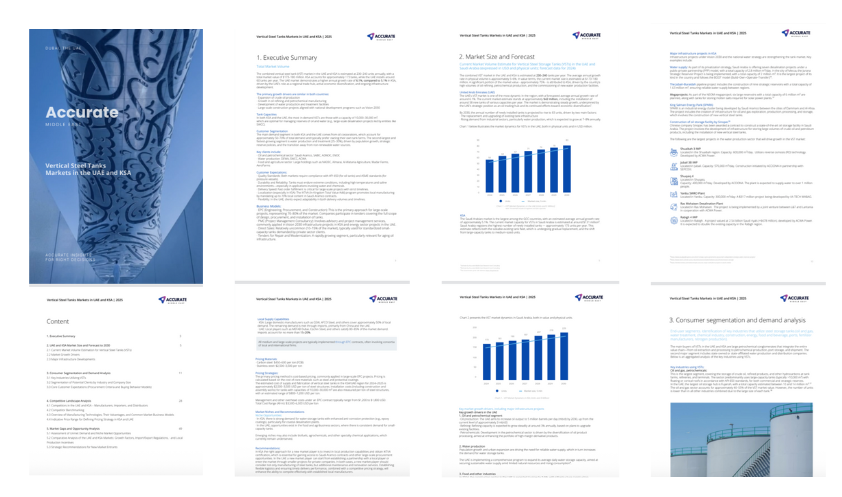
Market Analysis UAE
The scope is defined around the decision the client needs to make. Depending on the project, the analysis may combine secondary market data with primary research to validate assumptions that cannot be reliably assessed through published information alone.
What Is Market Analysis in the UAE?
Market analysis is the structured assessment of a specific market to understand its size, structure, demand, customer segments, competitors, pricing and future development. It helps companies determine how attractive a market opportunity is and which commercial factors may affect their decisions.
In the UAE, market conditions can vary significantly by industry, customer segment and Emirate. Official economic and business information published by the For UAE Government can provide useful context, while individual market assessments require more detailed sector-specific analysis.
Depending on the business decision, a UAE market analysis can provide:
- Market size, growth and demand — understanding the scale and development of the opportunity.
- Customer and buyer insights — identifying target segments, purchasing behaviour and decision criteria.
- Competitor and pricing intelligence — assessing key competitors, positioning, products and market pricing.
- Market trends and commercial conditions — identifying developments that may affect demand or competition.
- Opportunities, gaps and barriers — evaluating where opportunities exist and what may limit market potential.
What Does a Market Analysis Cover?
The scope depends on the business decision and the characteristics of the industry being assessed. A project may examine market size and growth, current and future demand, customer segments, competitors, pricing, distribution channels, market trends and potential barriers to growth.
For companies considering expansion, investment or a new product launch, the analysis can also identify where the strongest opportunities exist, how customers currently buy, which competitors are established in the market and what commercial conditions may affect the project.
When Do Companies Need Market Analysis?
Companies typically commission market analysis when they need evidence before making a significant commercial decision. Common situations include:
- Entering a new market — assessing demand, competition, pricing and market conditions before committing resources.
- Expanding an existing business — evaluating new customer segments, locations, channels or areas of growth.
- Launching a product or service — understanding demand, customer requirements, pricing and competing alternatives.
- Evaluating an investment — testing market assumptions before proceeding with a larger feasibility or investment assessment.
- Reviewing market position — understanding changes in competitors, customers, pricing or industry dynamics that may affect the business.
How We Conduct a Market Analysis
The methodology is defined around the business questions the analysis needs to answer. Depending on the project, market analysis may form part of a broader market research project, combining secondary data with primary research to validate market conditions, demand, pricing, customer behaviour and competitive dynamics.
1. Define the Business Questions
We start by understanding the decision the client needs to make and identifying the key questions the analysis should answer.
2. Define the Scope
We determine the target market, customer segments, geographic coverage, competitors, data requirements and research methodology.
3. Collect Market Data
We use relevant secondary sources such as government statistics, industry and company information, trade data, existing studies and competitor intelligence. Where published information is insufficient, we may conduct primary research through interviews, surveys or direct market engagement.

Market Analysis UAE Accurate Middle East
4. Analyse and Validate the Findings
The collected information is analysed and cross-checked to identify market size and demand, customer patterns, competitive conditions, pricing, trends, opportunities and potential barriers.
5. Develop the Market Analysis
The findings are brought together into a structured report with conclusions relevant to the original business decision. Depending on the scope, the report may also include forecasts, scenarios and practical recommendations.
How Much Does Market Analysis Cost in the UAE?
The cost of a market analysis depends on the scope of the project, the availability of reliable data, the research methodology and the level of primary research required. Key factors that influence the project cost include:
- Scope and geography — a focused analysis of one segment requires less research than a study covering multiple industries, Emirates or markets.
- Primary research — interviews, surveys, mystery shopping or other direct market research increase the time and resources required.
- Market size and demand assessment — projects requiring detailed market sizing, forecasting or bottom-up demand estimates typically involve additional analysis.
- Competitive and pricing analysis — the scope depends on the number of competitors, products and pricing points being assessed and the availability of commercial information.
- Depth of analysis — projects requiring detailed segmentation, forecasts or scenario analysis generally require a broader scope.
At Accurate Middle East, market analysis projects typically range from AED 25,000 to AED 65,000, depending on the scope and complexity of the assignment. A tailored proposal is prepared after the research objectives, required methodology and deliverables are defined.
Discuss Your Market Analysis Requirements
If you are evaluating a market opportunity, expansion, investment or new product in the UAE, Accurate Middle East can develop a tailored analysis around the specific questions your management team needs to answer.
Contact us at: team@meaccurate.com or call +971 50 559 5603 to discuss the scope and receive a customized proposal. Alternatively, you can complete our market research brief and share your project requirements with our team.
Frequently Asked Questions
Market analysis is the assessment of a specific market to understand its size, demand, customer segments, competitors, pricing, trends and commercial conditions. It helps companies evaluate opportunities and make informed decisions about investment, expansion, new products and business development.
Market analysis is the output — a structured read of market size, trends, and competitive positioning at a point in time. Market research is the process used to produce it: interviews, surveys, desk research, and data collection. In practice, a market analysis report is one deliverable that comes out of a market research engagement, not a separate service.
Most projects fall between AED 25,000 and AED 65,000, with the range driven by scope rather than sector. Studies limited to secondary research and desk analysis sit at the lower end; projects requiring primary research — B2B interviews, surveys, or mystery shopping — sit higher, because fieldwork costs scale with the number of respondents and the difficulty of reaching them.
Secondary research answers "what does the market look like." Primary research answers "how do buyers in this market actually decide." A company validating an existing assumption or benchmarking a known sector can often start with secondary sources. A company entering a new category, pricing a new product, or making an investment decision needs primary data — desk research alone cannot tell you why a customer chooses one supplier over another.
Market analysis answers whether demand exists and how the competitive field is structured. A feasibility study goes further and tests whether a specific business model is financially viable within that market — it adds cost structure, revenue modelling, and a viability conclusion. Companies still deciding if a market is worth entering start with market analysis; companies with a defined concept that need a go/no-go answer commission a feasibility study.
Timelines are set by data collection, not analysis. A desk-research-only study can close in 2–3 weeks. A study requiring primary interviews or surveys typically runs 4–6 weeks, since respondent scheduling — particularly for B2B interviews with decision-makers — is the actual constraint, not the reporting.
Three recurring uses: sizing a market before a launch or expansion decision, supporting an investment or funding conversation with third-party data instead of internal assumptions, and benchmarking a competitive set before a pricing or positioning change. The report format is built to be handed to a board, an investor, or a lender directly — not reworked first.
Manufacturing, real estate and construction, healthcare, and F&B account for most engagements, largely because entry costs in these sectors are high enough that companies want independent validation before committing capital. Technology and services companies commission it more often for competitive benchmarking than for entry validation.


