
One of the first questions we ask clients is not “What do you want to launch?” but “What exactly do you want to validate?” Those are two very different questions. During market validation projects across the UAE, we regularly see companies asking us to validate demand before defining their target customer, validate pricing before understanding customer expectations, or validate a business idea before confirming that the problem actually exists. In our experience, successful market validation starts with asking the right business question rather than choosing the right research methodology.
At Accurate Middle East, we believe market validation is successful only when it helps clients make better commercial decisions – not simply when it produces more research.

market validation
Before discussing research methodology, we first define the business decision the research is expected to support. Whether the objective is launching a new product, entering the UAE market, selecting a distributor, evaluating a new customer segment or assessing commercial feasibility, the research should provide evidence that helps management make a confident decision. The methodology comes afterwards.
What Is Market Validation?
Market validation is the process of collecting evidence that supports or challenges commercial assumptions before making important business decisions.
Depending on the project, validation may focus on:
- Market demand
- Market size
- Target audience
- Business concept
- Product-market fit
- Pricing
- Positioning
- Customer buying behaviour
- Market readiness
- Timing of market entry
These are completely different questions, and each requires a different research methodology.
One of the biggest mistakes companies make is assuming that one survey or one research method can answer all of them.
The Five Questions Every Market Validation Project Should Answer
| Question | Why it Matters |
| Is there genuine demand? | Without demand, there is no business. |
| Who will actually buy? | Many companies target the wrong audience. |
| Why would customers switch? | Existing alternatives often already solve the problem. |
| Is the market commercially attractive? | Demand alone does not guarantee commercial success. |
| Is this the right time to enter the market? | Even good ideas can fail if launched at the wrong time. |
Although these questions appear simple, they rarely have simple answers. Good validation combines multiple research methods to build confidence before investment.
Market Validation Starts with Challenging Assumptions
One lesson we have learned over the years is that clients often ask us to validate demand before they have actually defined their target customer. Research should never begin with just a data collection process. It should start with understanding exactly what assumptions already exist and if they are right or not. Some clients already have a good understanding of their competitors, customers and pricing. Others believe they do, but those assumptions have never been properly tested.
Even when clients come to us with a good market knowledge, we regularly challenge parts of the brief if something does not seem commercially logical. The objective of research is not to confirm existing opinions. This stage helps to discover whether those opinions are actually correct.
A Real Example: When the Wrong Audience Was Being Validated
A recent project illustrates this perfectly.
Our client had developed an innovative product and asked us to validate demand among Arabic-speaking consumers in the UAE. At first glance, the request appeared reasonable.
However, after reviewing their previous marketing activities, we discovered that all of their customer knowledge came from Arabic-language advertising campaigns. Because their advertisements had only been shown to Arabic-speaking audiences, the client concluded that Arabic speakers represented their primary target market. Instead of validating demand, we first suggested validating the target audience through customer analysis.
Once we expanded the analysis, it became clear that the potential customer base was significantly broader. The UAE consists of one of the world’s most multicultural populations, and limiting research to one language group would have excluded a large proportion of potential customers. The project therefore changed direction.
Instead of asking:
“Do Arabic-speaking customers want this product?”
we asked:
- Who actually needs this product?
- Which customer segments have the strongest demand?
- How do they currently solve this problem?
- Why would they switch to a new solution?
Only after answering those questions did demand validation become meaningful. Sometimes the most valuable outcome of market validation is discovering that the original business question was the wrong one.
Before defining the target audience, we also reviewed official demographic statistics to understand the structure of the UAE population. Publicly available data from the Federal Competitiveness and Statistics Centre (FCSC) provides valuable background on population, demographics and economic indicators, helping researchers build more accurate market assumptions before conducting primary research.
Market Validation Is Different from Startup Validation
Many articles discuss market validation from a startup perspective. In reality, most of our projects involve established companies entering new markets, launching new product lines, expanding into the UAE or Saudi Arabia, or testing commercial opportunities before making significant investments.
The approach when we work with a startup is different. When a completely new technology or business model has never existed before, no research can eliminate uncertainty entirely. Researchers can test customer reactions, explore adoption barriers, conduct concept testing and assess commercial interest, but predicting future behaviour always carries higher risk because there are few comparable examples.
Most startups however, are not introducing entirely new markets. They are introducing better products, improved services or entering markets where customers already buy similar solutions, which makes our work easier as we can validate their solutions based on existing market reality. In this case validation becomes much more reliable because existing customers, competitors, distributors, consultants and industry experts can all provide evidence that supports commercial decision-making.
This is why market validation for established industries is generally far more predictable than validation for entirely new technologies.
How We Typically Validate a Market
Although every project is different, most market validation studies combine several research methods.
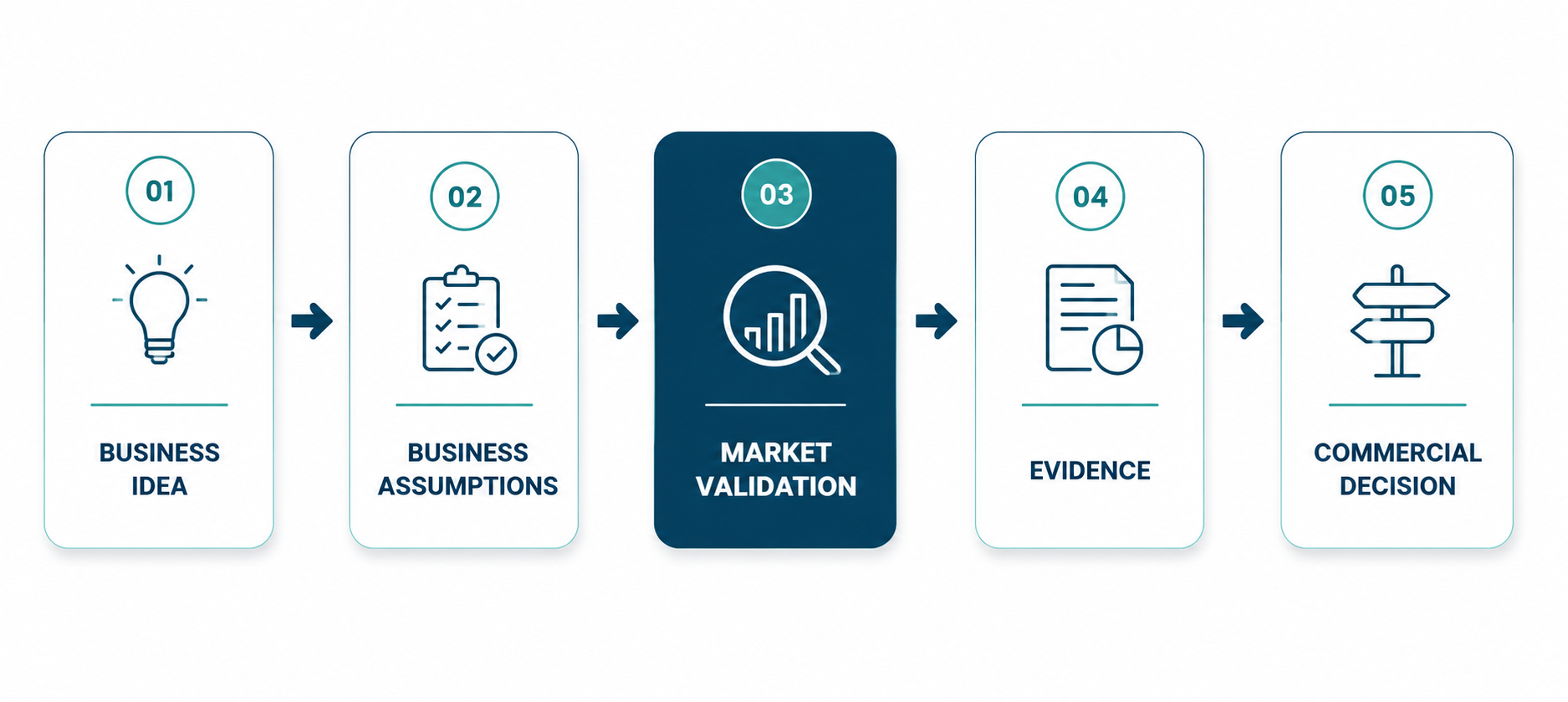
These may include:
- Secondary market research
- Competitor analysis
- Customer interviews
- Industry expert interviews
- Distributor interviews
- Surveys
- Focus groups
- Product or concept testing
- Retail observations
- Pricing research
The methodology depends entirely on the business questions being answered rather than applying the same process to every project.
Competitors Are Not Always Who You Think They Are
Another common misconception is believing there are no competitors simply because nobody sells the same product. We have worked with companies convinced they had no competition because no business offered exactly the same solution.
After mapping substitute products, customer buying behaviour and distribution channels, we discovered that customers were already solving the same problem in a completely different way. The challenge was therefore not creating demand. The challenge was convincing customers to change existing habits. Understanding substitute solutions is often far more valuable than simply listing direct competitors.
Market Validation vs Market Research
| Market Validation | Market Research |
| Tests business assumptions | Builds overall market understanding |
| Supports specific business decisions | Provides broader market intelligence |
| Focuses on demand, customers and commercial viability | Covers industries, competitors, trends and opportunities |
| Usually conducted before investment | Used throughout the business lifecycle |
| Answers “Should we proceed?” | Answers “What does this market look like?” |
Although the two are closely connected, they should not be confused. Market research provides information, market validation provides confidence to make decisions.
Case Study: Validating Demand in the UAE Automotive Market
One recent project involved validating the commercial opportunity for a company planning to supply products to the used car market in the UAE. The client’s initial question was straightforward: “Is there sufficient demand?”
However, after discussing the project objectives, it became clear that demand alone would not provide enough information to support an investment decision.
Instead, we expanded the validation to answer a broader set of commercial questions:
- Which types of automotive businesses would be the most likely buyers?
- Where do they currently source similar products?
- Which suppliers dominate the market today?
- What purchasing criteria influence supplier selection?
- What commercial terms do buyers expect?
- What unmet needs and market gaps still exist?
- Under what circumstances would buyers consider changing suppliers?
To answer these questions, we combined secondary market research with interviews involving used car dealerships, automotive businesses and industry stakeholders. The research showed that demand did exist. More importantly, it identified the buyer segments with the highest commercial potential, highlighted purchasing preferences and revealed several gaps that competitors were not fully addressing.
The project ultimately provided much more than demand validation. It helped the client understand how to position the product, which customer segments to prioritise, what commercial terms the market expected and where the strongest opportunities for market entry existed. This illustrates an important principle of market validation. Understanding that customers need a product is only the beginning. Successful market entry depends on understanding who buys, how they buy, why they buy and what would persuade them to choose a new supplier.
Types of Market Validation
| Validation Type | Typical Questions |
| Demand validation | Is there genuine customer demand? |
| Customer validation | Who will actually buy? |
| Product validation | Does the product solve the customer’s problem? |
| Pricing validation | Are customers willing to pay the proposed price? |
| Positioning validation | Does the value proposition resonate with the target audience? |
| Market size validation | Is the commercial opportunity large enough? |
Common Market Validation Mistakes
The same issues appear repeatedly across industries.
The most common include:
- Trying to validate demand before defining the target audience.
- Confirming existing assumptions instead of challenging them.
- Asking customers whether they like an idea instead of understanding how they currently solve the problem.
- Ignoring substitute products because they are not identical competitors.
- Assuming demand automatically means commercial success.
- Relying only on online surveys without speaking directly to customers, distributors or industry experts.
- Using global market data without validating whether the findings apply to the UAE or Saudi Arabia.
Conclusion
Successful market validation is not about proving that a business idea is right. It is about reducing uncertainty before important commercial decisions are made.
In our experience, the most valuable outcome of a validation project is often not confirming an assumption but identifying where it should be challenged. Sometimes the research validates the original concept. In other cases, it reveals a different target audience, a stronger commercial opportunity or a more effective market positioning before significant investment takes place.
Every market validation project should ultimately provide one thing: evidence that supports better business decisions.
Whether you are evaluating a new product, expanding into the UAE or Saudi Arabia, entering a new customer segment or testing market demand, the objective remains the same—to replace assumptions with reliable market evidence before committing resources.
Contact us directly via WhatsApp or call us in the UAE at +971 50 559 5603. You can also request a callback or schedule a free consultation by clicking the button below.
Need to validate a business idea or market opportunity?
Our consultants help businesses validate demand, customer needs, pricing, positioning and commercial opportunities across the UAE, Saudi Arabia and the wider GCC using primary and secondary market research.
Request a consultation |
WhatsApp us
Get a proposal within 24 hours
Frequently Asked Questions
Market validation is the process of testing business assumptions before making commercial decisions. Depending on the project, it may involve validating customer demand, the target audience, pricing, product positioning, market size or commercial feasibility. The objective is to replace assumptions with evidence before investing in a new product, market or business opportunity.
Business idea validation typically begins by defining the commercial decision the research is expected to support. Depending on the objectives, the process may include competitor analysis, customer interviews, surveys, focus groups, concept testing and secondary market research. In the UAE, validation should also consider the country's diverse population, purchasing behaviour and local market dynamics rather than relying solely on global research.
Market research provides information about an industry, competitors and customers. Market validation goes one step further by testing whether a specific business idea, product or commercial assumption is likely to succeed. While market research builds knowledge, market validation helps businesses make investment and market entry decisions with greater confidence.
Every project is different, but businesses commonly validate:
Customer demand
Target audience
Product concept
Pricing
Positioning
Customer buying behaviour
Market size
Commercial feasibility
Distribution channels
Competitive landscape
The priority depends on the business objectives and the decision the research is expected to support.
The timeline depends on the research objectives, methodology and geographic scope. A focused market validation project may take two to four weeks, while larger studies involving customer surveys, interviews, focus groups and competitor analysis typically require four to eight weeks.
Yes. Although no research can eliminate risk completely, market validation significantly reduces uncertainty by testing business assumptions before investment. It helps companies understand customer needs, buying behaviour, competitive dynamics and commercial opportunities before entering a new market or launching a new product.
Absolutely. Many B2B market validation projects focus on understanding purchasing behaviour, procurement processes, supplier selection criteria and unmet customer needs rather than simply measuring demand. Interviews with buyers, distributors, industry experts and decision-makers often provide more valuable insights than surveys alone.
Market validation should be completed before making significant commercial decisions such as launching a new product, entering a new country, selecting a distributor, investing in production, opening a new location or developing a go-to-market strategy. Validating assumptions early is usually far less expensive than correcting mistakes after launch.
There is no single methodology suitable for every project. Depending on the objectives, market validation may combine desk research, competitor analysis, customer interviews, industry expert interviews, surveys, focus groups, concept testing, pricing research and retail or field observations. The methodology should always be selected after defining the business questions rather than before.


