

Last Updated: 11 November 2026
UAE Hotel Supply in 2026: Rooms, Pipeline and New Openings
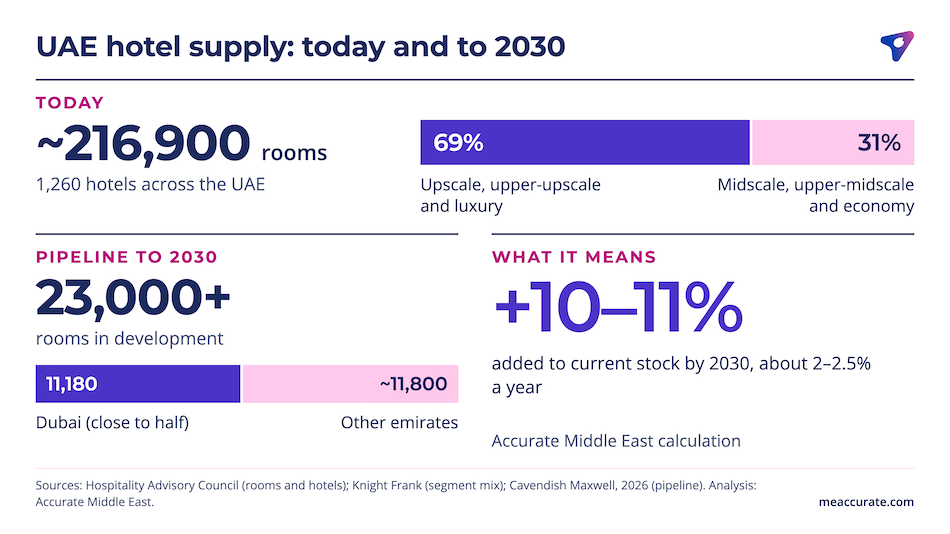
The UAE has around 216,900 hotel rooms across 1,260 hotels, according to the Hospitality Advisory Council. Most of that stock is high-end: upscale, upper-upscale and luxury hotels make up 69% of rooms (Knight Frank). It is a market built around high-spending international visitors, which is exactly the demand that weakened in 2026.
The pipeline is more modest than the headlines suggest. Just over 23,000 UAE rooms are in development to 2030, according to Cavendish Maxwell’s 2026 GCC hospitality research, adding roughly 10–11% to current stock. In a normal year the market absorbs that comfortably. In a recovery year, it is a different calculation.
| Supply indicator | Figure | Source |
|---|---|---|
| Existing hotel rooms | ~216,900 (1,260 hotels) | Hospitality Advisory Council |
| Upscale, upper-upscale and luxury share | 69% of rooms | Knight Frank |
| Rooms in development to 2030 | 23,000+ | Cavendish Maxwell |
| of which Dubai | 11,180 | Cavendish Maxwell |
| Implied supply growth to 2030 | ~10–11% (~2–2.5% a year) | Accurate Middle East calculation |
What changed in 2026 is timing. Much of the regional pipeline was committed before the conflict began, and operators are now adjusting opening dates. For anyone planning a new hotel, the question is no longer how many rooms are coming, but when they open and what occupancy they open into. Delayed projects risk opening around the same time, in 2027–2028, while demand is still rebuilding.
| Supply indicator | Figure | Source |
|---|---|---|
| Existing hotel rooms | ~216,900 (1,260 hotels) | Hospitality Advisory Council |
| Upscale, upper-upscale and luxury share | 69% of rooms | Knight Frank |
| Rooms in development to 2030 | 23,000+ | Cavendish Maxwell |
| of which Dubai | 11,180 | Cavendish Maxwell |
| Implied supply growth to 2030 | ~10–11% (~2–2.5% a year) | Accurate Middle East calculation |
What changed in 2026 is timing. Much of the regional pipeline was committed before the conflict began, and operators are now adjusting opening dates. For anyone planning a new hotel, the question is no longer how many rooms are coming, but when they open and what occupancy they open into. Delayed projects risk opening around the same time, in 2027–2028, while demand is still rebuilding.
Dubai: The Regional Benchmark for Hospitality
Dubai remains the region’s unrivaled hospitality powerhouse. In the first seven months of 2025, the emirate welcomed 11.17 million international visitors, up 5.2% year-on-year, while the average occupancy rate reached 79.1% — one of the highest in the world.
The average length of stay increased to 3.7 nights, with a total of 25.5 million occupied room nights between January and July 2025. Dubai International Airport (DXB) maintained its position as the world’s busiest international airport for the 11th consecutive year, handling 92.3 million passengers in 2024.
The composition of visitors is increasingly diversified:
- Western Europe (21%)
- GCC countries (16%)
- Eastern Europe (15%)
- South Asia (15%)
- MENA (11%)
Luxury and upper-upscale hotels dominate the city’s supply, representing 47% of rooms, while lifestyle aparthotels and branded residences are the fastest-growing sub-segments.
This evolution underscores Dubai’s dual positioning — both as a global tourism capital and as an investment destination for institutional and private investors seeking stable returns from hospitality assets.
Dubai: Largest Market, Sharpest Swing
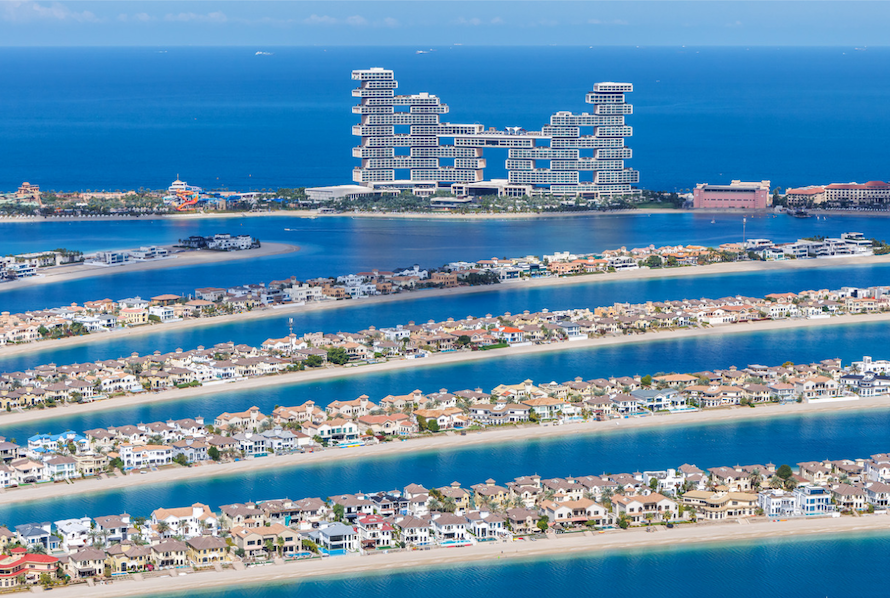
Dubai holds around two-thirds of the UAE’s hotel rooms, close to 149,000 by the end of August 2026 (Dubai Department of Economy and Tourism). It came into the year at a high point: 19.59 million international overnight visitors in 2025, the city’s third record year in a row. It also took the hardest hit once the conflict started, with the steepest occupancy decline of any emirate in the first half.
The visitor numbers show the scale. Dubai received 6.97 million international visitors from January to August 2026, against 12.54 million in the same months of 2025, a fall of about 44%. Hotel occupancy bottomed out at 36% in March. Arrivals have grown by double digits every month since, and August brought 869,000 visitors, the best month since February, with occupancy back at 66%. DET also reports that load factors at Dubai International are approaching 2025 levels.
No single market dominates Dubai’s demand, which gives the city more than one route back. Western Europe accounted for 20% of international visitors in the first eight months, South Asia for 17% and the GCC for 16%. Mid-market hotels also kept higher occupancy than premium properties through the first half, a point worth weighing for anyone deciding on positioning for a new project.
On costs, Dubai introduced an AED 2.5 billion relief package in two phases, exempting hotels and restaurants from the Tourism Dirham and other fees to protect their cash flow. Events are the other lever. Arabian Travel Market moved from May to September this year, and the autumn business events calendar is now an important part of the recovery picture.
Dubai also carries close to half of the UAE’s development pipeline, with 11,180 rooms due by 2030 (Cavendish Maxwell). The city is recovering month by month, but visitor numbers for the year are still well below 2025, and new rooms will open into a market that has not yet rebuilt its pre-conflict demand.
Abu Dhabi and the Northern Emirates: Where Demand Held Up
Dubai’s numbers dominate the national picture, so the rest of the country gets less attention than it deserves. In 2026 the other emirates behaved quite differently, mainly because more of their guests already live in the UAE.
Abu Dhabi: Domestic Demand and Events
Abu Dhabi lost about half as much occupancy as Dubai. CoStar data cited by CBRE shows the capital at 66.8% for the first half of 2026, down from 80.3%. In June it ran at 65.2%, the highest of any emirate, carried by domestic and government-linked demand.
That does not mean Abu Dhabi escaped. RevPAR in June was still 12.1% lower than a year earlier. Full rooms and full revenue are not the same thing.
What protects the capital is its calendar. Formula 1, Abu Dhabi Sustainability Week and the World Future Energy Summit bring demand on fixed dates, whatever happens to leisure travel. The Grand Prix is going ahead this year, while Bahrain and Saudi Arabia lost theirs. Add the 2025 base, when hotel revenues rose 19.5% to AED 9.1 billion and MICE delegates grew 40% to 2.2 million according to DCT Abu Dhabi, and you have a market that bends rather than breaks. The catch is that event demand is concentrated. A new hotel here has to make money on the ordinary weeks too.
Ras Al Khaimah: Resort Growth in a Smaller Market
RAKTDA announced a record first half: 670,000 visitors, with domestic arrivals up 47%. Hotel owners in the emirate would probably describe it another way. Occupancy was 19 points lower than in the first half of 2025, mostly in the 30s and low 40s between March and June, and the average stay shrank by almost a third. Residents drove up for the weekend and went home. Room rates held roughly at 2025 levels, which helped.
We would not model any RAK hotel project on a single demand curve. Wynn Al Marjan Island opens in 2027, the emirate wants to double its room stock by 2030, and it is targeting 3.5 million annual visitors. The market before Wynn and the market after Wynn need separate assumptions.
Sharjah and Fujairah: Value and Leisure Segments
Sharjah is where the mid-market sits. Cavendish Maxwell’s 2025 figures:
- 102 hotels, around 10,700 keys
- 2.1 million guests, up 22%
- 78% occupancy at an average rate of AED 305
- an average stay of two nights
Much of that demand comes through Sharjah International Airport, which handled 19.5 million passengers last year, 14% more than in 2024.
Fujairah reported 95% to 100% occupancy in early 2026, before the disruption, according to its Department of Tourism and Antiquities. We have not yet seen reliable first-half figures for either emirate, so we would treat both as unknowns until the full-year data is out.
Hotel Investment in the UAE: Transactions in 2026
Deals slowed in 2026, but they did not stop. In June, AHS Properties bought the Shangri-La Hotel on Sheikh Zayed Road for AED 1.1 billion, close to US$300 million. With 302 rooms, that works out at roughly AED 3.64 million per key. CoStar described it as the first prominent hotel transaction in the UAE since the war began. The buyer’s own explanation was blunt: “We did not buy a hotel. We bought a position on a corridor.”
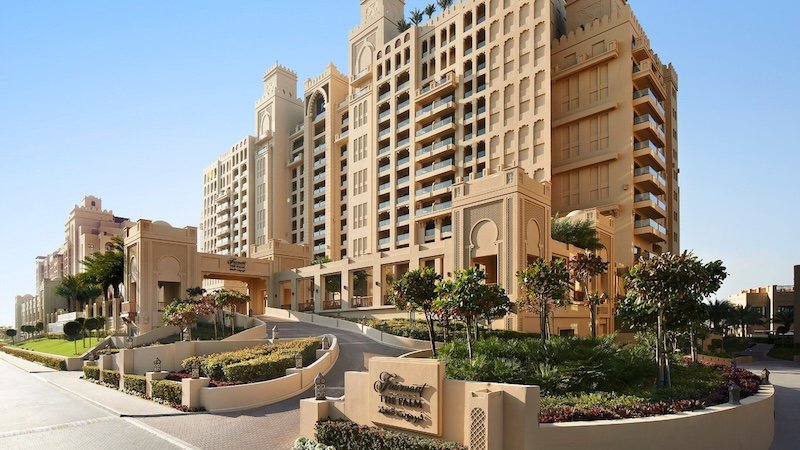
Read the price with care. The sale came in about 57% above the asset’s 2020 auction price, but according to MMCG Invest the terms were agreed before the conflict and closed unchanged. The same applies to Fairmont The Palm, sold in the second half of 2025 for US$325 million (391 keys) to Arzan Investment Management. These prices reflect pre-war expectations. They are not a clean read on what UAE hotels are worth today.
Investors know this. Most valuations are being redone because the demand and occupancy forecasts behind them no longer hold, and the buyers still active are mostly GCC family offices, high-net-worth individuals and private investors, with growing interest from Indian hotel owners. Development projects are mostly being delayed rather than cancelled.
A few practical points for anyone looking at a UAE hotel acquisition:
- Most deals are off-market, and a sale process typically takes six to twelve months.
- Acquisition financing usually runs at 40–60% loan-to-value.
- Valuations are based on 10-year discounted cash flow models, which is exactly where 2026 hurts: the occupancy assumed in years one and two now matters far more than it did a year ago.
For context, Dubai alone saw around AED 4.7 billion in hotel transactions in 2025 (Al Tamimi & Company). Prices and terms for most deals are never disclosed, so any figure on the UAE hotel investment market is a partial picture.
UAE Hospitality Market Outlook: What to Expect in 2027
The recovery has started, but unevenly. Dubai’s visitor numbers have grown every month since March, occupancy was back at 66% in August, and load factors at Dubai International are close to 2025 levels. Cavendish Maxwell expects Dubai to finish 2026 at between 60.4% and 66.2% occupancy, with momentum building from the fourth quarter as flight connections improve and the winter season begins.
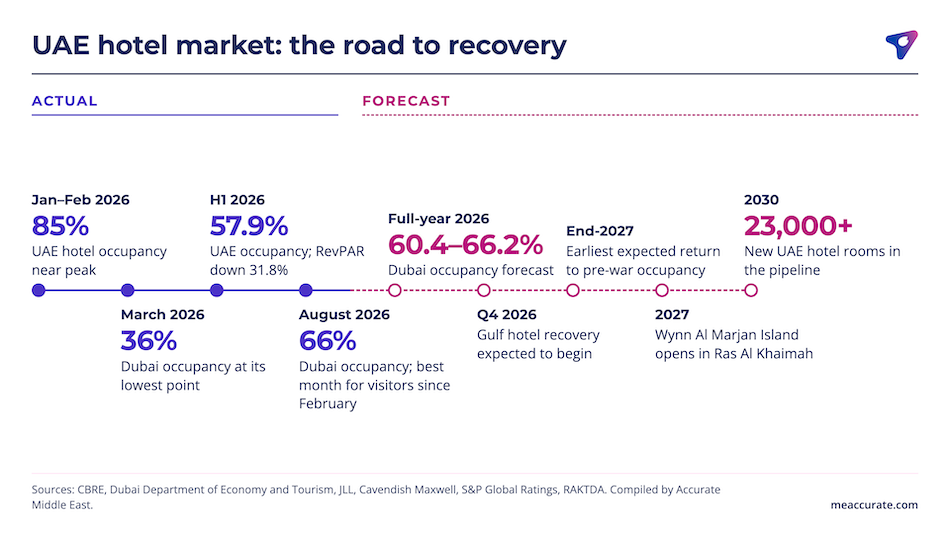
Getting back to where the market was will take longer. S&P Global Ratings does not expect Gulf hotels to reach pre-war occupancy before the end of 2027. Our reading is that most of the recovery will come through occupancy rather than rates. Hotels largely held their prices through the downturn, so there is little discounting to reverse, and RevPAR growth in 2027 will depend on filling rooms again.
So what will 2027 look like? Most likely a recovery year rather than a growth year. One thing to keep in mind when the numbers come out: year-on-year figures will look strong simply because 2026 was so weak. The more honest benchmark for owners and investors is 2025. Supply will pick up at the same time. Wynn Al Marjan Island is due to open in Ras Al Khaimah, and some of the projects delayed this year are likely to open in 2027 and 2028, competing for the same recovering demand.
Over the next twelve months, we will be watching four things:
- whether the winter season brings Dubai occupancy back towards 2025 levels
- how many delayed hotel projects reschedule their openings into 2027 and 2028
- the return of long-haul international travel
- the opening of Wynn Al Marjan Island in 2027 and its effect on Ras Al Khaimah’s hotel market
We will update this analysis when full-year 2026 figures are published in early 2027.
Planning a Hotel Project in the UAE?
If you are weighing a site, a concept or an acquisition, the questions above are where we start. Our team prepares hotel feasibility studies and market research in the UAE for investors, developers and operators, built on current demand data rather than last year’s assumptions.
Tell us about the project, the location and the opening date you have in mind.
WhatsApp: Message our team
Email: team@meaccurate.com
Office: IN5 Tech, Dubai Internet City, Dubai, UAE
Callback: Request a call
Frequently Asked Questions
UAE hotels averaged about 85% occupancy in January and February 2026, according to CBRE. After the regional conflict began in March, occupancy for the first half of the year fell to 57.9%, with RevPAR down 31.8% (JLL). Dubai has been recovering since, reaching 66% occupancy in August.
The UAE has around 216,900 hotel rooms across 1,260 hotels, according to the Hospitality Advisory Council. Just over 23,000 more are in development to 2030, close to half of them in Dubai (Cavendish Maxwell).
Abu Dhabi. Its occupancy fell from 80.3% to 66.8% in the first half of 2026 (CoStar data cited by CBRE), about half of Dubai’s decline, and in June it had the highest occupancy in the UAE at 65.2%. Domestic, government-linked and event-driven demand kept the capital ahead.
S&P Global Ratings expects Gulf hotels to start recovering in the fourth quarter of 2026, but not to return to pre-war occupancy before the end of 2027. For Dubai, Cavendish Maxwell forecasts full-year 2026 occupancy of 60.4% to 66.2%.
It depends on the segment, the location and the opening date. A hotel opening in 2027 or 2028 will open into a market that is still recovering, so the numbers should be tested against actual 2026 performance, not 2025 levels. Midscale hotels held occupancy better than upscale ones in 2026, while high-end leisure hotels relying on long-haul travel were hit hardest.
2027 is expected to be a recovery year. S&P Global Ratings does not expect Gulf hotels to return to pre-war occupancy before the end of 2027, and with room rates largely held through the downturn, most of the recovery is likely to come through occupancy. New supply will add pressure, with Wynn Al Marjan Island opening in Ras Al Khaimah and part of the 23,000-room pipeline reaching completion.


