
Last Updated: 26 October 2026
Healthcare is one of those markets where a broad industry report is rarely enough to make a commercial decision. A hospital considering a new specialty, a medical company assessing demand, an investor evaluating a clinic concept and an international healthcare business entering the UAE may all be looking at the same sector. But they need completely different answers.
Accurate Middle East provides healthcare market research in the UAE for healthcare providers, investors, medical companies and businesses that need evidence before making an investment, market-entry, expansion, product or service decision.

Healthcare Market in the UAE
Our work is built around the actual commercial question. Depending on the project, this may involve market sizing, demand analysis, competitor research, patient or physician research, pricing, primary interviews, surveys, regulatory analysis, market entry assessment or feasibility support. We work across Dubai, Abu Dhabi and the wider UAE healthcare market.
The aim is straightforward: find out what is happening in the market, test the assumptions that matter, and give management enough evidence to make the next decision.
Healthcare Market Research Is Not One Type of Study
Healthcare projects tend to arrive with very different questions.
One client may want to know whether there is enough demand for a new medical service. Another needs to understand why patients are choosing competing clinics. A medical manufacturer may be looking for distributors. An investor may need to compare Dubai and Abu Dhabi before committing capital.
That is why we do not begin with a standard healthcare report. We begin with the decision.
Typical questions include:
-
-
- Is there enough demand for the proposed healthcare service or product?
- Who are the main providers and how strong are they?
- Which specialties or patient groups appear underserved?
- How are competing clinics, hospitals or healthcare companies positioned?
- What prices are patients, providers or buyers currently seeing?
- How do patients choose between providers?
- What do physicians, distributors or procurement teams think about a new product?
- What are the realistic routes to market?
- Which regulatory requirements affect commercial feasibility?
- Should the company enter, expand, change the concept or stop?
-
The methodology is then designed around those questions.
UAE Healthcare Market in 2026: What the Latest Data Shows
The UAE healthcare sector continues to expand, supported by population growth, mandatory health insurance, private-sector investment and rising healthcare utilisation.
Dubai’s latest official figures provide a useful indication of current demand. Data published by Dubai Health Authority in February 2026 shows that health-insurance beneficiaries exceeded 4.9 million in 2025, compared with around 4.6 million in 2024. Insurance claims increased even faster, reaching approximately 49.6 million, up from 43.69 million a year earlier.
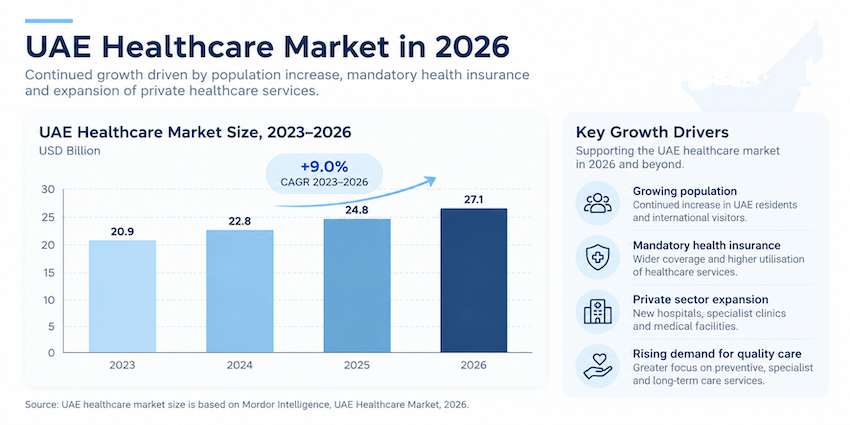
UAE healthcare market outlook for 2026, highlighting estimated market growth from 2023 to 2026 and key drivers including population growth, mandatory health insurance, private-sector expansion and rising demand for quality care.
The increase in claims is particularly relevant because it points to growing utilisation of healthcare services, not simply a larger insured population.
For investors and healthcare operators, however, overall market growth does not guarantee sufficient demand for a particular specialty, clinic model, medical product or location. Commercial potential can differ significantly by patient group, insurance coverage, catchment area, provider density and competitive intensity.
The UAE Healthcare Market Requires Local Evidence
The UAE has a sophisticated healthcare system, a substantial private sector and a highly diverse patient population.
Dubai alone recorded 5,372 licensed healthcare facilities in 2024, including 57 hospitals, according to Dubai Health Authority statistics. The same official data shows a large healthcare workforce operating across hospitals, clinics, pharmacies and specialist facilities.
DHA’s investment data also shows the importance of the private sector in healthcare delivery in Dubai. Private facilities accounted for the majority of both outpatient and inpatient activity in the latest published comparison.
Dubai Healthcare Demand Indicators, 2024-2025
Dubai’s latest healthcare utilisation data also points to continuing demand growth. Dubai Health Authority reported more than 4.9 million health-insurance beneficiaries in 2025, up by around 6.5% year on year, while insurance claims increased by approximately 13.5% to nearly 49.6 million.
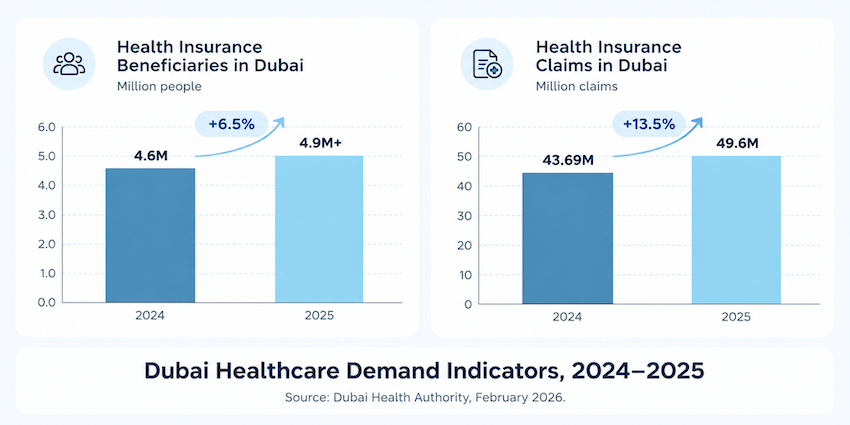
Source: Dubai Health Authority, 2026
These figures point to growing healthcare activity, but they do not mean that every specialty, location or service concept has sufficient demand. Headline growth can hide major differences by specialty, catchment area, insurance mix, patient profile and competitive intensity.
For an investor, healthcare provider or medical company, this is where project-specific healthcare market research becomes important. Official sector information is available through the Dubai Health Authority.
You still need to know where the demand sits, which providers are actually competing for the same patient or buyer, what patients are willing to pay, how insurance affects behaviour, and whether the proposed offer is sufficiently different from what already exists.
Those questions normally require more than secondary data. You still need to know where the demand sits, which providers are actually competing for the same patient or buyer, what patients are willing to pay, how insurance affects behaviour, and whether the proposed offer is sufficiently different from what already exists.
Those questions normally require more than secondary data.
What We Research in the UAE Healthcare Sector
| Research Area | Questions We Address |
|---|---|
| Market demand | How large is the relevant opportunity and where is demand concentrated? |
| Competitor analysis | Who competes directly, what do they offer and how are they positioned? |
| Patient research | What do patients need, value, avoid and pay for? |
| Provider research | How do doctors, clinics, hospitals and other healthcare stakeholders make decisions? |
| Pricing | What are current price points and how does pricing vary across providers and services? |
| Market entry | What is the practical route into the UAE market? |
| Feasibility | Can the concept generate sufficient demand and support the required investment? |
| Location | Which emirate, catchment or location is better suited to the proposed model? |
Healthcare Market Sizing and Demand Analysis
The most common mistake in healthcare market sizing is starting with a very large headline number. A national healthcare expenditure figure does not tell a specialist clinic how many patients it can realistically attract. Neither does a broad CAGR. For commercial decisions, the market normally needs to be narrowed. Depending on the project, we may assess: relevant patient population; service utilisation; number and capacity of competing providers; insured versus out-of-pocket demand; geographic catchment; referral patterns; service penetration; pricing and frequency of use; planned healthcare capacity; realistically addressable demand.
When reliable published figures do not exist, the estimate may need to be built from the bottom up. That can involve provider counts, capacity, patient volumes, interviews, price observations and other market-level evidence.
Competitor Analysis for Hospitals, Clinics and Healthcare Businesses
Knowing the names of the largest healthcare providers is not competitor analysis. The useful question is: which providers compete for the same patient, service, referral, contract or buyer?
Our healthcare competitor analysis may examine:
-
-
- locations and geographic coverage;
- medical specialties;
- services and treatment mix;
- pricing;
- insurance acceptance where relevant;
- physician profiles;
- patient access and booking;
- service positioning;
- digital presence;
- customer experience;
- market reputation;
- visible strengths and gaps.
-
The competitor set can be very different from the list of the UAE’s largest healthcare groups.
A specialist centre in Dubai may compete with only a handful of providers for its core service. A medical product company may compete against brands distributed through hospitals rather than against healthcare facilities themselves. The research needs to reflect the actual commercial battlefield.
Primary Research in Healthcare
Some of the most useful healthcare information is simply not public. Published data may show how many hospitals exist. It usually will not tell you why a physician prefers one solution, why patients reject a package, what a distributor expects from a new manufacturer or what would make a clinic change supplier. This is where primary research becomes important.
Depending on the project, we may speak with:
-
-
- patients and healthcare consumers;
- physicians;
- clinic and hospital management;
- procurement teams;
- medical distributors;
- pharmacists;
- insurers and other market stakeholders;
- industry specialists.
-
Methods can include surveys, in-depth interviews, focus groups and expert interviews. See our Primary Research UAE service for more information on how we design first-hand research.
Healthcare Consumer and Patient Research
Healthcare decisions are not purely rational purchasing decisions: doctors, price, insurance, reviews, the reputation of the provider, convenience, language and sometimes the opinion of family or friends. Many factors matter. When a healthcare business wants to introduce a new service or product, simply asking whether people are “interested” is not enough. Research may need to explore:
-
-
- actual need;
- current behaviour;
- purchase barriers;
- provider selection;
- trust;
- service expectations;
- price sensitivity;
- willingness to pay out of pocket;
- insurance influence;
- likelihood of changing provider;
- conditions that turn interest into purchase.
-
Healthcare Consumer Research Case
For one UAE healthcare provider, Accurate Middle East was asked to validate demand for a proposed portfolio of healthcare and wellness services before the client committed to product development and launch.
The study combined a 500+ respondent survey across Dubai and Abu Dhabi, three focus groups and eight in-depth interviews. Price sensitivity was included because stated interest alone was not enough to establish whether consumers would actually buy the proposed services.
The work identified commercially relevant customer segments, purchase barriers, pricing parameters and changes needed to strengthen the proposed offer.
Read the Healthcare Consumer Research UAE case study.
Patient Satisfaction and Healthcare Experience Research

Healthcare Report Medical Market Research UAE Accurate ME
Existing patients require a different type of research. Here the question is not whether demand exists. It is whether patients are satisfied with what they already receive and where the experience may be failing.
We can assess areas such as:
-
-
- booking;
- waiting time;
- reception;
- staff interaction;
- communication;
- comfort and privacy;
- follow-up;
- overall satisfaction;
- likelihood to return or recommend.
-
Patient Satisfaction and Clinic Benchmarking Case
In another UAE assignment, a clinic asked us to determine whether its patients were genuinely satisfied and whether its performance was broadly stronger, weaker or in line with relevant external benchmarks. The research examined different stages of the patient journey rather than relying on one overall satisfaction question. The aim was to separate individual comments from recurring patterns and give management a practical baseline for service improvement.
Read the Patient Satisfaction Research and Clinic Benchmarking case.
B2B Healthcare Market Research
Not every healthcare assignment involves patients. Medical devices, equipment, pharmaceuticals, healthcare technology and specialist services often operate through a more complicated B2B buying process. The relevant decision-makers may include physicians, clinical teams, procurement, hospital management, distributors or regulatory stakeholders.
In these projects, research may examine:
-
-
- current products and suppliers;
- clinical and technical requirements;
- procurement criteria;
- supplier approval;
- distribution structure;
- pricing and margins;
- switching barriers;
- decision-makers and influencers;
- interest in a new product or solution.
-
Healthcare Pricing Research
Healthcare pricing can be surprisingly difficult to compare. The same broad treatment category may be offered through different packages, physician levels, consultation structures or insurance arrangements. For that reason, price benchmarking needs a clear definition of what is actually being compared.
Depending on the assignment, we may collect and analyse:
-
-
- consultation prices;
- treatment prices;
- diagnostic prices;
- package structures;
- promotional offers;
- membership models;
- competitor price ranges;
- patient price sensitivity.
-
The goal is not simply to produce a price list. It is to understand how pricing relates to positioning, demand and the economics of the proposed service.
Healthcare Market Entry in the UAE
International healthcare businesses often approach the UAE with a strong concept but limited knowledge of how the local commercial system works.
Before entering, they may need to validate:
-
-
- market demand;
- target patient or buyer segment;
- competitive position;
- regulatory route;
- distribution or partnership model;
- pricing;
- location;
- commercial viability.
-
Market entry research should answer these questions before significant resources are committed. And occasionally the research shows that the proposed opportunity is not strong enough. That is still a useful result.
Healthcare Feasibility Studies
A healthcare feasibility study goes further than market research. Once demand has been established, the next question is whether the business itself can work financially and operationally.
Depending on the concept, feasibility work can combine:
-
-
- demand assessment;
- competitor analysis;
- service mix;
- location considerations;
- pricing;
- patient-volume assumptions;
- staffing;
- capital expenditure;
- operating costs;
- revenue forecasts;
- cash flow;
- break-even;
- investment scenarios.
-
Market assumptions and financial assumptions should be built together. A financial model is only as useful as the demand assumptions underneath it.
Healthcare Market Research in Dubai
Dubai is a large and competitive healthcare market with private hospitals, specialty clinics, medical centres, diagnostic providers and healthcare businesses serving both residents and international patients. For research purposes, “Dubai healthcare market” is still often too broad.
A clinic may compete within a particular catchment. A premium specialty provider may draw patients from a much wider area. A medical product company may sell across the entire emirate through institutional buyers. We therefore define the relevant Dubai market according to the business model rather than treating the whole emirate as one customer pool.
Healthcare Market Research in Abu Dhabi
Abu Dhabi has its own healthcare structure, regulatory environment, provider landscape and investment priorities. Research involving Abu Dhabi therefore needs to be assessed separately rather than assuming that evidence from Dubai applies automatically.
Depending on the assignment, we may compare provider capacity, specialty availability, pricing, patient segments, commercial competition and demand conditions across the two emirates. The comparison is useful when a company genuinely needs to choose between locations. It should not be done simply because both markets are in the UAE.
What a Healthcare Market Research Project Can Include
A project may include some or all of the following:
-
-
- market size and demand assessment;
- competitor mapping and benchmarking;
- patient or consumer research;
- physician and healthcare professional interviews;
- B2B buyer research;
- pricing analysis;
- regulatory research;
- distribution and channel analysis;
- location assessment;
- market-entry recommendations;
- feasibility and financial modelling support.
-
We do not recommend including every workstream simply to make the study larger. The scope should answer the decision.
Why Healthcare Research Often Needs Both Desk and Primary Research
Secondary research is useful for understanding regulation, healthcare infrastructure, broad market trends and published statistics, but the data is very limited. If the question is whether physicians would adopt a new product, whether patients will pay for an uncovered service or why procurement teams reject a supplier, published data is unlikely to provide the answer. Primary research fills that gap. The strongest healthcare studies often use both.
Desk research establishes what is already known. Primary research tests what matters specifically to the client’s decision.
Who Uses Our Healthcare Market Research
Our healthcare research can support:
-
-
- hospitals and clinic groups;
- specialist medical centres;
- healthcare investors;
- medical device companies;
- health-tech businesses;
- diagnostic providers;
- international healthcare companies entering the UAE;
- healthcare product manufacturers;
- distributors;
- private investors evaluating healthcare concepts.
-
What You Receive
The deliverable depends on what management needs to decide.
It may include:
-
-
- market assessment;
- data tables and evidence base;
- competitor profiles;
- primary research findings;
- patient or stakeholder segmentation;
- pricing analysis;
- demand estimates;
- commercial risks;
- market-entry options;
- recommendations;
- financial assumptions where feasibility is included.
-
The purpose is not to produce the longest healthcare report. It is to give management a defensible answer to the question that triggered the project.
Healthcare Market Research vs a Published Healthcare Report
A published healthcare report is useful when you need general information about sector size, trends and major players. Custom healthcare market research is different. It begins with your product, service, target patient, location, competitor set and commercial decision. If your question is specific, the research should be specific too. For broader information about our research approach across sectors, see our Market Research UAE page.
Discuss Your Healthcare Market Research Requirements
If you are evaluating a healthcare investment, new medical service, product launch, market entry or expansion in the UAE, we can first define what evidence is actually needed before proposing the research methodology.
Talk to our 24/7 AI assistant on WhatsApp and receive a tailored proposal within 24–48 hours. You can also email us at team@meaccurate.com or call us in the UAE on +971 50 559 5603.
 | |
Author: | |
| Dr. Elena Zhukovskaya Senior Consultant, Partner | |
| 20+ years of experience in market research, business management, investor relations, and brand communications across the UAE, KSA, and GCC. Author of 50+ publications and a regular speaker at leading business events in the region. Linkedin profile |

Frequently Asked Questions
Healthcare market research in the UAE is the analysis of demand, competitors, patients, providers, pricing, regulations and buying behaviour to support market entry, investment, expansion and commercial decisions.
A healthcare market research study in the UAE typically includes market sizing, demand assessment, competitor analysis, pricing, patient research, provider interviews, regulatory review and market-entry or feasibility support.
Yes. Demand validation can combine patient population data, competitor capacity, service utilisation, pricing, catchment analysis and direct patient or stakeholder research to assess whether a clinic or medical service has a realistic addressable market.
Yes. Healthcare market research can cover the UAE nationally or focus specifically on Dubai, Abu Dhabi or another emirate. Where market conditions differ, each location should be analysed separately.
Yes. Primary healthcare research can include patient surveys, focus groups, physician interviews, hospital or clinic management, procurement teams, distributors and other relevant healthcare stakeholders.
Healthcare market research assesses demand, competition, patients, pricing and market conditions. A healthcare feasibility study goes further by adding operating assumptions, staffing, investment requirements, revenue forecasts, cash flow, break-even and financial viability.
The cost of healthcare market research in the UAE depends on the scope, sample size, target respondents, geography and methodology. Projects involving patient surveys, physician interviews or multiple primary research workstreams require a higher budget than desk-based market assessments.


