
Last Updated: 28.07.2026
For B2B companies entering Saudi Arabia, identifying demand is only the first step. Commercial success depends on having a clear go-to-market strategy that defines how target customers will be reached, how the product or service will be positioned, and how revenue will be generated. Without that commercial structure, even a strong offering can struggle to gain market traction.
A B2B go-to-market (GTM) strategy brings together customer segmentation, positioning, pricing, sales channels and commercial execution into a single framework. For companies expanding into Saudi Arabia, where procurement processes, distributor networks and buying behaviour often differ from other markets, a structured GTM strategy is an essential part of successful market entry.
What Is a GTM Strategy
A go-to-market strategy is a structured approach to how a company introduces a product or service to a defined customer segment and generates revenue.
It answers a limited set of practical questions:
- Who exactly will buy
- Why will they choose this offer over alternatives
- How the company will reach and convert them
In a B2B context, these decisions are rarely linear. Sales cycles are longer, multiple stakeholders are involved, and purchasing decisions are often tied to budget cycles rather than immediate need.
This is why a GTM strategy is not interchangeable with marketing. It sits between product definition and sales execution.
B2B Go-to-Market Strategy: Key Considerations
A B2B go-to-market strategy in Saudi Arabia should reflect how purchasing decisions are actually made rather than relying on assumptions from other markets.
Commercial success is influenced by more than product quality or price. Decision-making often involves multiple stakeholders, procurement requirements and technical evaluations, which can make sales cycles longer and less predictable than companies initially expect.
Choosing the right route to market is equally important. While some industries support direct sales, others rely heavily on distributors, local partners or system integrators that already have established customer relationships. Selecting the wrong commercial model can delay market entry, increase customer acquisition costs and limit long-term growth.
Pricing also requires local validation. A pricing strategy that performs well in Europe or North America may not reflect customer expectations or competitive dynamics in Saudi Arabia.
 For these reasons, a B2B go-to-market strategy should combine customer validation, competitive intelligence, pricing analysis and channel selection into a single commercial framework. Marketing plays an important role in execution, but it cannot compensate for weak positioning, unrealistic pricing or an ineffective sales model.A well-developed go-to-market strategy helps companies reduce commercial risk before significant investments are made. Without this foundation, businesses may generate interest and leads but still struggle to convert them into sustainable revenue. For additional reading on developing an effective go-to-market strategy, see Harvard Business Review, which regularly publishes research on strategy, commercial growth and market expansion.
 Why Market Validation Matters Before Market Entry
Saudi Arabia has become one of the fastest-growing economies in the GCC, supported by Vision 2030 initiatives aimed at increasing private sector participation, attracting foreign investment and diversifying the economy beyond oil. As new industries emerge and competition intensifies, companies entering the market face more opportunities—but also greater pressure to make the right commercial decisions from the outset.
B2B purchasing decisions have also become more complex. Gartner buying committee research indicates that a typical B2B buying group now involves between 6 and 10 decision-makers, each bringing different priorities and evaluation criteria. For companies entering Saudi Arabia, this means that successful market entry depends not only on generating awareness but also on understanding procurement processes, customer expectations and the most effective commercial route to market before investing in sales and marketing.
When Companies Need a Consultant?
Companies typically engage external support at specific moments, not continuously.
The most common situations include:
- entering a new market such as Saudi Arabia
- launching a new product or category
- experiencing low conversion despite active sales efforts
- preparing for investment or scaling
In these cases, the cost of misalignment is not only financial. It also affects timelines, team focus, and market perception.
GTM Strategy vs Marketing Strategy
| GTM Strategy | Marketing Strategy |
|---|---|
| Positioning | Promotion |
| Pricing | Campaigns |
| Channels | Content |
| Sales model | Advertising |
| Revenue model | Lead generation |
What’s Important for B2B?
Go-to-market strategy consulting services support companies in structuring these decisions before resources are deployed.
In practice, market entry focuses on:
- validating target segments and demand
- defining positioning and pricing logic
- selecting realistic channels and sales approach
- aligning commercial assumptions with financial outcomes
The market entry services are particularly relevant when internal teams have product clarity but lack market-specific execution experience.
A strategy consultant should be able to challenge assumptions, not only document them.
Key Elements of a Go-to-Market Planning
A structured go-to-market plan connects several elements that must work together. Weakness in one area tends to affect the entire execution.
| Element | What It Defines | Typical Risk if Misaligned |
|---|---|---|
| Target Segment | Who the company is selling to | Low conversion despite high activity |
| Value Proposition | Why the offer is relevant | Price pressure or lack of differentiation |
| Channel Strategy | How customers are reached | High acquisition cost, low visibility |
| Pricing Logic | How the product is monetized | Mismatch with willingness to pay |
| Sales Process | How deals are converted | Long cycles, inconsistent pipeline |
A plan to go to market should not be treated as a checklist. It is a system where each component influences the others.
Which GTM Approach Fits Your Business?
| Situation | Recommended Approach |
|---|---|
| New product | Customer validation first |
| New country | Market entry GTM |
| Existing product with low sales | Positioning review |
| Enterprise software | Account-based GTM |
| Industrial products | Distributor and direct sales model |
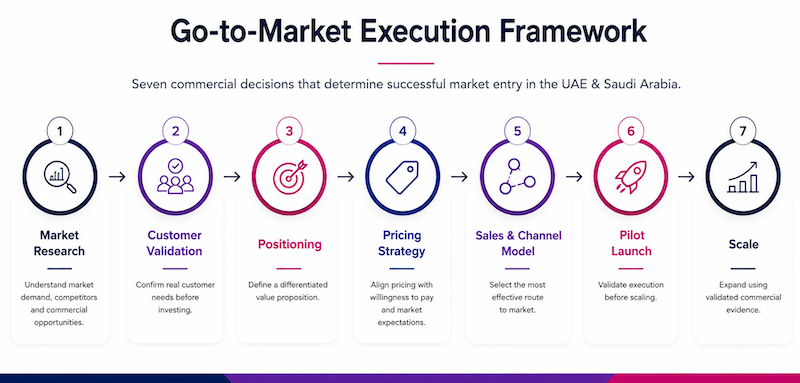
Our Go-to-Market Framework for Saudi Arabia
Instead of treating GTM as a marketing exercise, we normally evaluate seven commercial dimensions before recommending an execution model.
- Customer demand validation
- Buyer decision journey
- Competitive positioning
- Commercial pricing
- Distribution model
- Sales process
- Financial viability
Each decision influences the others. For example, selecting a distributor instead of building a direct sales team changes pricing, customer ownership, margins and long-term scalability. A successful GTM strategy therefore requires commercial decisions to be evaluated together rather than independently.
Cost and Timeline
The cost of developing a market entry strategy depends on the level of validation required. A focused engagement — including segmentation, positioning, and channel definition — typically takes four to six weeks. More comprehensive work, including customer interviews, demand validation, and financial modeling, extends to six to eight weeks.
Typical ranges in the GCC market:
| Scope | Timeline | Estimated Cost (SAR) |
|---|---|---|
| GTM Strategy (core structure) | 4–6 weeks | 55,000 – 75,000 |
| GTM Strategy + Market Validation | 6–8 weeks | 70,000 – 110,000 |
Lower-cost options exist, but they often focus on marketing execution rather than strategic alignment.
Real-World Examples
Cosmetics Manufacturing Market Entry – Saudi Arabia
A cosmetics manufacturer planned to establish local production and launch a new product portfolio tailored to the Saudi market. Before investing in manufacturing capacity, the company required an evidence-based go-to-market strategy to validate demand, define the right product mix and identify the most attractive customer segments.
Accurate Middle East conducted market research, competitor benchmarking, customer analysis, pricing assessment and financial modelling. The project resulted in a validated product portfolio, commercial positioning, pricing strategy and investor-ready business plan that supported the client’s manufacturing investment decision.
Explore the Saudi cosmetics case study →
Medical Products Market Entry – Saudi Arabia
An international healthcare company engaged Accurate Middle East to assess the commercial potential of introducing medical products into the Saudi Arabian market. The objective was to identify the most attractive customer segments, evaluate market demand, understand the competitive landscape and develop an evidence-based market entry strategy before committing resources.
The project combined B2B market research, competitor benchmarking, customer and distributor analysis, regulatory assessment and commercial recommendations. The outcome was a structured go-to-market strategy that helped the client define its target market, optimise its commercial approach and reduce market entry risk.
Explore the Medical Products Saudi Arabia case study →
What Makes Accurate Middle East Different
Most consulting firms rely on publicly available information, manual desk research and outsourced fieldwork. While these approaches remain valuable, they can significantly extend project timelines and limit the depth of commercial intelligence available to clients.
At Accurate Middle East, we combine traditional consulting methodologies with proprietary technology, established regional research infrastructure and on-the-ground execution teams across the GCC. This enables us to deliver evidence-based go-to-market strategies faster while validating assumptions through multiple independent sources.
1. Proprietary Market Intelligence Platform
Our proprietary market intelligence platform, MARSA Manufacturing, automates the collection and analysis of commercial market data. Instead of manually reviewing hundreds of websites, our platform can rapidly collect competitor information, product portfolios, technical specifications, pricing references, public tenders, supplier information and other commercial signals that would traditionally require weeks of manual research. This allows our consultants to spend more time analysing data and less time gathering it.
2. Access to More Than 56,000 Industry Professionals
Primary research remains a critical part of every B2B go-to-market strategy. Over the years, Accurate Middle East has developed access to a network of more than 56,000 business professionals, decision-makers and industry experts across the GCC. This significantly reduces recruitment time for expert interviews, customer validation studies and industry consultations, allowing projects to progress more efficiently while maintaining research quality.
3. Local Research Teams in Saudi Arabia and the UAE
Successful market validation often requires local execution rather than remote research alone. Our field teams in Saudi Arabia and the UAE conduct business interviews, customer research, competitor visits, mystery shopping and commercial validation directly in the market. This enables us to obtain first-hand market intelligence without relying exclusively on third-party agencies, improving both speed and data quality.
By combining automated intelligence, primary research and local execution, we provide clients with commercially validated recommendations rather than assumptions based solely on secondary research.
Discuss Your Task with US
If you are entering Saudi Arabia or preparing to launch a new production or product, the critical question is not visibility — it is whether your commercial model will convert. Reach out to our team today via email team@meaccurate.com or via WhatsApp.
We will review your approach and outline a structured plan aligned with your market and objectives.
 | |
Author: | |
| Ekaterina Novikova Senior Researcher | |
| 15+ years of experience in feasibility studies, market studies, business intelligence in the UAE, KSA, and GCC. Senior Researcher at Accurate Middle East Research and Consulting in Dubai. Linkedin profile |

Frequently Asked Questions
A B2B go-to-market strategy typically includes customer segmentation, value proposition development, competitive positioning, pricing strategy, channel selection, sales process design and revenue planning. Depending on the project, it may also include customer interviews, distributor assessment, competitor benchmarking and financial modelling. The objective is to build a commercially viable market entry strategy rather than simply a marketing plan.
A typical go-to-market strategy takes 4 to 6 weeks, depending on the complexity of the market and the amount of research required. Projects that include primary customer interviews, competitor intelligence or financial modelling generally require 6 to 8 weeks to complete.
A market entry strategy focuses on entering a new country or region and addresses questions such as market attractiveness, regulations, business setup and entry options. A go-to-market strategy focuses on commercial execution—how the product or service will be positioned, priced, sold and delivered to customers. For companies expanding into Saudi Arabia, both strategies are often developed together.
Yes. B2B purchasing decisions usually involve multiple stakeholders, longer sales cycles and formal procurement processes. As a result, a B2B go-to-market strategy places greater emphasis on customer segmentation, pricing, channel strategy, distributor selection and sales execution than a typical consumer-focused launch.
Companies typically engage a go-to-market strategy consultant when entering a new market, launching a new product or experiencing slow commercial growth. An independent consultant helps validate market assumptions, identify commercial risks, optimise pricing and recommend the most effective route to market before significant investments are made.


