


Last Updated: March, 28 2026
In the UAE, demand can change faster than most businesses expect — driven by seasonality, regulation, pricing shifts, and consumer behavior. According to the UAE Ministry of Economy, ongoing economic diversification continues to reshape demand patterns across key industries. Without accurate demand forecasting, companies risk overproduction, stock imbalances, and missed revenue opportunities.
This is why demand forecasting in the UAE is not just an analytical exercise, but a critical part of market entry, expansion, and operational planning.
In industries ranging from retail, FMCG, to healthcare, wellness and beauty, to construction and manufacturing, accurately forecasting demand enables businesses to plan operations, allocate resources, and stay ahead of competitors.
When Do Companies Need Demand Forecasting in the UAE?
In the UAE, demand rarely follows a straight line. It is shaped by seasonality, pricing sensitivity, shifting consumer preferences, and regulatory changes. As a result, companies typically require demand forecasting in the UAE at specific decision points — not as a one-time exercise, but as part of ongoing business planning.
The most common situations include:
Entering a new market
Before launching in the UAE, companies need to understand whether real demand exists, how large the opportunity is, and which customer segments are most relevant. Without this, market entry decisions are often based on assumptions rather than data.
Launching a new product or concept
New product success in the UAE depends heavily on positioning, pricing, and timing. Demand forecasting helps estimate expected sales volumes, identify early adopters, and align marketing and distribution strategies.
Scaling production or expanding operations
As businesses grow, forecasting becomes critical for aligning production capacity, staffing, and supply chain planning with realistic demand scenarios.
Planning inventory and supply chain operations
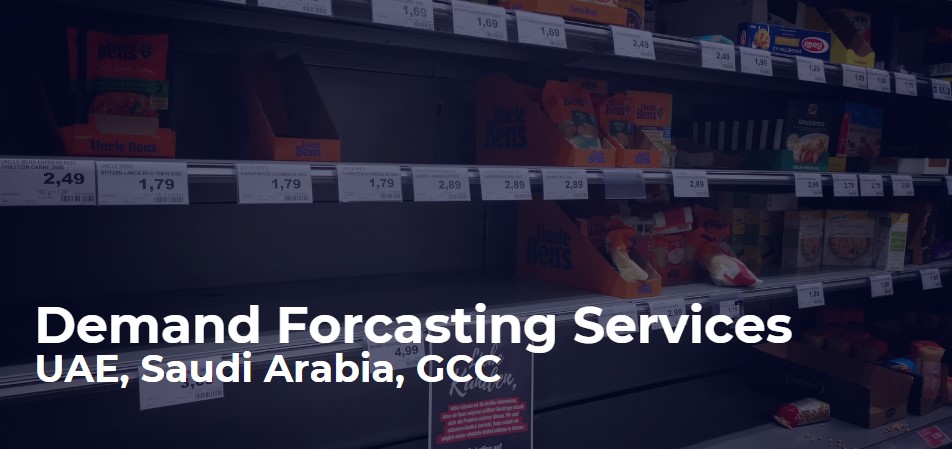
In sectors such as retail and FMCG, inaccurate forecasts lead to overstocking or stockouts — both of which directly impact margins and customer satisfaction.
Why is Demand Forecasting Important in UAE?
The UAE in particular and GCC markets in general are marked by:
- Rapid Development and Diversification: New sectors emerge, old ones transform.
- Seasonal and Cultural Variations: For instance, demand for luxury goods spikes during Ramadan.
- Regulatory Changes: Policies such as the introduction of VAT and sustainability rules affect buying habits.
- Consumer Behavior Shifts: Trends driven by young people, the influence of social media, and the rise of digital adoption are changing demand more quickly than before.
Without accurate demand forecasting, companies risk:
- Overstocking or Stockouts: Both incur financial losses.
- Inefficient Supply Chains: Leading to higher costs and lost sales.
- Missed Growth Opportunities: Particularly in new market segments or product categories.
How Demand Forecasting Works in Practice (UAE Market Approach)
Effective demand forecasting in the UAE combines data analysis with local market understanding. Rather than relying on a single model, a structured approach typically includes:

Demand Forecasting UAE 2026
Market and demand baseline assessment
Estimating total market size, segment demand, and consumption patterns across relevant customer groups
Historical data analysis (where available)
Reviewing internal sales data, seasonality trends, and past performance to identify demand patterns
External market inputs
Incorporating pricing benchmarks, competitor activity, economic indicators, and regulatory factors that influence demand
Scenario-based forecasting
Building multiple demand scenarios (conservative, realistic, and high-growth) to reflect market uncertainty
Seasonality and behavioral adjustments
Accounting for UAE-specific demand fluctuations, including Ramadan, tourism cycles, and summer seasonality
Validation through qualitative insights
Supporting data with expert interviews, customer research, or market testing where required
This combined methodology allows businesses to move beyond static projections and develop realistic, decision-ready demand forecasts aligned with the UAE market environment.
Who Can Benefit from Demand Forecasting in the UAE?
Retail Chains & FMCG Companies: Optimize stock levels and prevent stockouts.
Manufacturers: Align production planning with expected demand
Healthcare Providers: Forecast medical supplies and pharmaceutical needs.
Logistics & Supply Chain Operators: Plan capacities and routes based on demand projections.
Investors & Startups: Validate market potential before scaling up.
Case Study: Demand Forecasting for FMCG Product Launch (UAE)
A food & beverage company approached us before launching a new product with unconventional packaging. Initial assumptions about demand were unclear.
Our analysis combined consumer research, competitor benchmarking, and seasonal demand modeling.
Result:
- Identified a clear market opportunity
- Optimized positioning and messaging
- Supported a successful launch, leading to a 20% increase in sales during peak season
Where Demand Forecasting Fails in the UAE
Despite increasing access to data and analytical tools, many demand forecasting projects in the UAE fail to deliver accurate or actionable results. In most cases, the issue is not the lack of data, but how it is interpreted within a fast-changing and highly segmented market environment.
The most common pitfalls include:
Over-reliance on historical data
Past performance does not reliably predict future demand in the UAE, where market conditions shift quickly due to new entrants, pricing changes, and external demand drivers such as tourism and economic cycles
Ignoring seasonality and local demand patterns
Demand is heavily influenced by periods such as Ramadan, Eid, and the summer season. Forecasts that do not reflect these cycles often lead to inaccurate planning and inventory imbalances
Misreading expat vs. local demand dynamics
The UAE is not a uniform market. Purchasing behavior varies significantly between expatriate and local populations, requiring segmentation rather than a single demand assumption
Failure to adjust for regulatory and market changes
Updates in VAT, import regulations, or sustainability policies can quickly impact demand levels, making static forecasting models insufficient
In practice, accurate demand forecasting in the UAE requires combining data analysis with local market insight and continuous validation, rather than relying on a single model or historical dataset.
Cost of Demand Forecasting Services in the UAE
The cost of demand forecasting services in the UAE depends on several factors, including the complexity of the market, availability of data, number of products, and forecasting horizon. Unlike standardized services, demand forecasting requires a tailored analytical approach, combining quantitative models with market intelligence.
In practice, pricing varies based on the depth of analysis and the business objective — whether it is a quick demand validation for a single product or a comprehensive forecasting model supporting market entry or expansion.
Typical pricing ranges in the UAE are as follows:
| Project Scope | Typical Deliverables | Estimated Cost (AED) |
|---|---|---|
| Fundamental Forecast (1 product, 1 market) | Baseline demand estimation, high-level assumptions, short-term forecast | 25,000 – 35,000 |
| Comprehensive Forecast (Multi-product / multi-segment) | Detailed demand modeling, segmentation, scenario analysis, medium- to long-term forecast | 35,000 – 65,000+ |
| Ongoing Forecasting & Dashboards | Continuous monitoring, automated models, interactive dashboards, regular updates | Custom pricing |
Our Step-by-Step Process with Clients
- Client Briefing: Understanding your business objectives, current challenges, and forecasting needs.
- Data Collection:
- Internal data: Historical sales, CRM data, inventory and supply parameters.
- External data: Market trends, economic indicators, competitor activities.
- Model Selection & Customization: Our specialists apply the most suitable forecasting model based on your data and industry.
- Analysis & Forecast Development: Producing short, medium, and long-term forecasts.
- Scenario Planning: Offering projections under various economic or regulatory scenarios.
- Recommendations: Strategic insights on how to align operations, marketing, and supply chain to forecasted demand.
- Delivery of Insights:
- Comprehensive PDF report.
- Interactive Excel model for dynamic scenario testing.
- Optional dashboard solutions for ongoing monitoring.
Stay Ahead of Competitors with Accurate Demand Insights
In a region as dynamic as the GCC, demand forecasting is a must-have strategic tool, not a premium feature. It enables companies to align production, marketing, and operations with future demand, ensuring sustained growth and profitability.
At Accurate Middle East, we blend careful analysis with local knowledge to provide demand forecasting solutions that support decision-making. In a fast-changing area like the GCC, demand forecasting is essential, not optional. It allows companies to match their production capacity, marketing, and operations with future demand. This alignment ensures ongoing growth and profitability for business.
Ready to Forecast Your Business Future?
For inquiries, consultations, or custom proposals, contact us directly on WhatsApp at or call us in the UAE at +971 50 599 5603. You can also request a callback or schedule a free consultation by clicking the button below. If you’re interested in market research services, just fill out our short form here and receive a tailored proposal within 24 hours.
We’re here to support your business goals across the UAE, Saudi Arabia, and the GCC.


