
Most companies entering Saudi Arabia do not underestimate demand. They underestimate competition.
Not in terms of how many competitors exist — that is usually visible. The issue is how those competitors actually operate: pricing flexibility, relationships, distribution control, and informal advantages that don’t appear in reports.
This is where competitor analysis becomes practical, not descriptive. It is used to understand what you are really competing against — not what looks similar on paper. In Saudi Arabia, competition is shaped not only by product and pricing, but also by access to clients, local partnerships, and regulatory structure.
At the same time, a competitive benchmark helps answer a different question: not who exists, but what level of performance is required to compete at all.
Without both, companies tend to enter the market positioned correctly in theory, but misaligned in practice.
What Is Competitor Analysis

Competitor Analysis in Saudi Arabia
Competitor analysis is the process of identifying who you compete with and how they win customers in the market you are entering.
In Saudi Arabia, this goes beyond listing companies or comparing product features. In many sectors, competitors differ less in product and more in execution — how they price, who they know, and how they access customers. In the Saudi market, this often requires going beyond visible competitors and understanding how local players structure deals and maintain relationships over time.
A useful competitor analysis focuses on:
- how competitors generate revenue, not just what they offer
- how they structure pricing in real deals, not list prices
- how they reach customers — directly or through intermediaries
Without this level of detail, companies often misjudge both the intensity of competition and the effort required to win initial clients.
Competitive Benchmark vs Competitor Analysis in Saudi Arabia
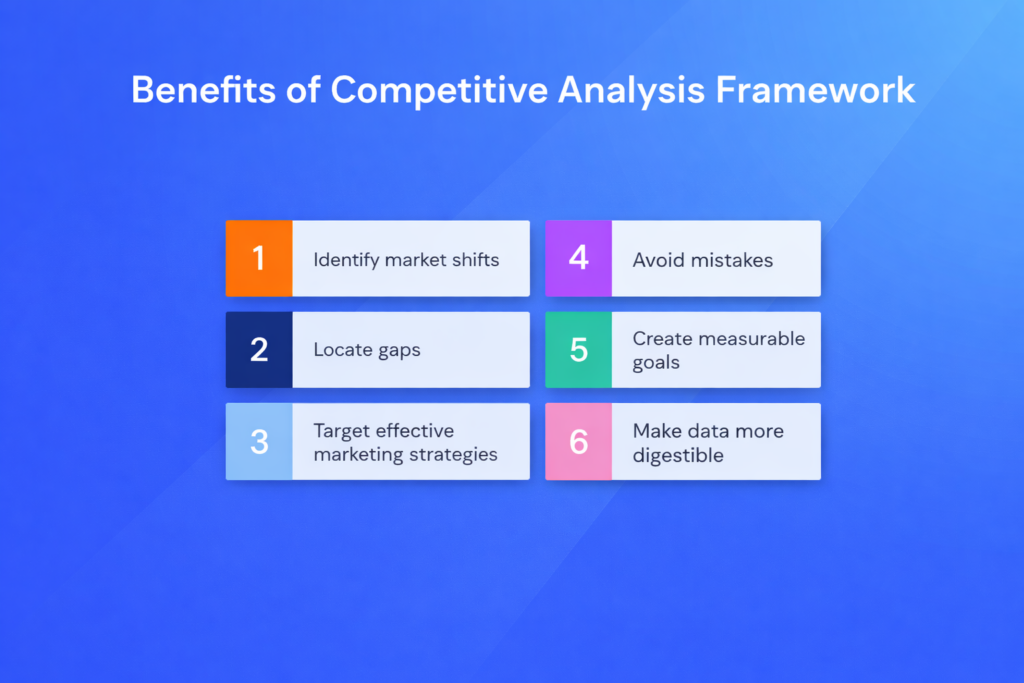
Competitive Benchmark Analysis in Saudi Arabia
The two are often treated as interchangeable, but they solve different problems.
Competitor analysis looks outward — who is in the market and how they operate.
A competitive benchmark looks inward — whether your company is positioned at a level that can compete.
For example, a company may identify competitors correctly but still fail because:
- its pricing is above acceptable market range
- its service model does not match expectations
- its sales cycle assumptions are unrealistic
A competitive benchmark sets a reference point. It defines what “competitive” actually means in that specific market.
Without it, companies tend to assume that being “better” is enough. In practice, alignment matters more than superiority.
A structured competitive benchmark analysis combines several perspectives rather than relying on one source of information.
In Saudi Arabia, three methods are typically used together. The relative importance of each method can vary depending on the sector, especially in markets where distribution and access play a larger role than product differentiation.
The first is market mapping. This identifies not only direct competitors, but also alternative solutions that compete for the same budget.
The second is pricing and positioning analysis. This is where many assumptions break. List prices rarely reflect actual deals. Discounts, bundling, and relationship-based pricing are common.
The third is channel and access analysis. Some competitors are strong not because of product advantages, but because they control distribution or have established relationships with key buyers.
A proper competitive benchmark analysis connects these elements. It does not isolate them.
How Businesses Use Competitive Benchmarking
A competitive benchmark is not an output. It is used to make decisions. In practice, leading strategy work often treats benchmarking as a decision tool rather than a reporting exercise — an approach reflected in insights published by McKinsey & Company. For example see this report.
Companies typically apply it in three situations. In Saudi Arabia, these adjustments are often required earlier, as initial assumptions based on other GCC markets do not always hold.
First, before entering a market. The objective is to understand whether the current business model is viable or requires adjustment.
Second, during repositioning. When sales are inconsistent, benchmarking helps identify whether the issue is pricing, targeting, or channel selection.
Third, during expansion. As companies scale, they often move into segments where competitive expectations differ. What worked initially may no longer hold.
In each case, the competitive benchmark provides a reference point for decision-making, not just a comparison.
Competitor Analysis Service for Market Strategy in KSA

Competitive Benchmarking in Saudi Arabia
A competitor analysis service is typically used when internal teams have partial visibility, but not enough to make confident decisions.
Most companies already know their obvious competitors. What they lack is clarity on:
- how those competitors actually win deals
- where they are vulnerable
- what trade-offs they are making
A structured competitor analysis service focuses on decision points. It connects competitor behavior with strategic implications — pricing adjustments, channel choices, or entry timing.
The goal is not to describe the market, but to reduce uncertainty before committing resources.
When Companies Need Professional Competitive Benchmark Analysis in Saudi Arabia
Companies rarely invest in competitor analysis at the very beginning. More often, they reach this stage after encountering friction.
Typical signals are familiar.
Sales activity is high, but conversion is inconsistent. Pricing discussions become difficult earlier than expected. Competitors appear to have advantages that are not immediately clear.
In Saudi Arabia, this situation is common for companies entering from other GCC markets. The structure looks similar, but execution differs.
This is where competitive benchmark analysis becomes necessary. It helps identify whether the issue is external — market conditions — or internal — positioning and model.
Professional support is usually required when:
- the cost of misalignment is already visible
- internal assumptions are no longer reliable
- decisions need to be made quickly, but with limited visibility
At this stage, the objective is not to gather more information. It is to clarify what needs to change.
Why Accurate Middle East
Accurate Middle East works on situations where companies need clarity before adjusting strategy or entering a new market.
Our approach to competitor analysis combines market observation with commercial logic. We focus on how competitors actually operate — not only how they present themselves.
At the same time, we use competitive benchmark frameworks to assess whether a client’s model is aligned with market expectations.
This allows decisions to be made early, before misalignment translates into lost time or cost.
Discuss Your Competitor Analysis
If you are entering Saudi Arabia or facing inconsistent market traction, the issue is often not effort — it is positioning relative to competitors.
Reach out to our team today via email team@meaccurate.com or via WhatsApp.
We will review your current position and structure a competitor analysis in Saudi Arabia that reflects how your market actually works.
Frequently Asked Questions
Competitor analysis is used to understand how other companies win clients — pricing, positioning, channels. It’s less about listing competitors and more about how they actually operate in the market.
Competitor analysis looks at external players. Competitive benchmarking evaluates whether your own model — pricing, offering, positioning — is strong enough to compete.
Because not all advantages are visible. Local players often rely on relationships, distribution, or access that are not obvious from outside the market.
Before entering a market, or when performance doesn’t match expectations. At that point, it helps identify whether the issue is positioning, pricing, or channel.
Usually market mapping, pricing analysis, and channel evaluation. The focus is on how competitors win deals, not just how they present themselves.


